
2.2. Speed and Velocity
The average speed is a scalar quantity defined as the distance traveled divided by the amount of time taken to travel this distance.
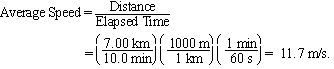
Example 2If, in Example 1, the car takes 10.0 minutes to travel from its initial to its final position, what is its average speed?
| |
The average velocity is a vector quantity defined as the displacement divided by the elapsed time. In general, the average speed is not the same as the magnitude of the average velocity. There is one special case where these two quantities will be equal. When an object travels in a straight line and does not change the direction of motion, the average speed of the object over any time interval will be equal to the magnitude of the average velocity over the same time interval.
Example 3Find the average velocity of the car in Examples 1 and 2.
 | |
Notice that the average speed and the magnitude of the average velocity are not the same.
The instantaneous velocity indicates both how fast and in what direction an object is moving at a particular instant of time. To determine the instantaneous velocity we measure the time
 | |
 essentially means that we want to isolate an instant of time and find the velocity during that instant. The instantaneous speed is simply the magnitude of the instantaneous velocity.
|