A primary focus of this chapter has been projectile motion. This section presents two additional examples that serve as a review of the basic features of this type of motion. Example 12 deals with the fact that projectile motion consists of a horizontal and a vertical part, which occur independently of one another. Example 13 stresses the fact that the time variable has the same value for both the horizontal and vertical parts of the motion.


Concepts & Calculations Example 12  Projectile Motion

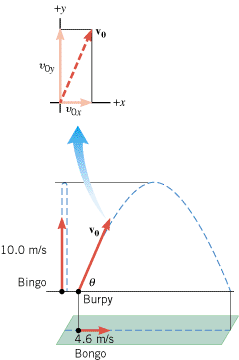
In a circus act, Burpy the clown is fired from a cannon at an initial velocity v0 directed at an angle above the horizontal, as Figure 3.21 shows. Simultaneously, two other clowns are also launched. Bingo is fired straight upward at a speed of 10.0 m/s and reaches the same maximum height at the same instant as Burpy. Bongo, however, is launched horizontally on roller skates at a speed of 4.6 m/s. He rolls along the ground while Burpy flies through the air. When Burpy returns to the ground, he lands side by side with his roller-skating friend, who is gliding by just at the instant of landing. Ignore air resistance, and assume that the roller skates are unimpeded by friction. Find the speed v0 and the angle for Burpy.

Example 12 discusses the projectile motion shown here, in which three circus clowns, Burpy, Bongo, and Bingo, are launched simultaneously.
Figure 3.21  Example 12 discusses the projectile motion shown here, in which three circus clowns, Burpy, Bongo, and Bingo, are launched simultaneously.

Concept Questions and Answers Is Bongo’s left-to-right motion the same as or different from the horizontal part of Burpy’s motion along his trajectory?

Answer   The horizontal and vertical parts of projectile motion occur independently of one another. Therefore, since Burpy lands side by side with Bongo, Bongo’s left-to-right motion is identical to the horizontal part of Burpy’s motion along his trajectory.

Is Burpy’s motion in the horizontal direction determined by the initial velocity v0, just its horizontal component v0x, or just its vertical component v0y?

Answer   Just the horizontal component v0x determines Burpy’s motion in the horizontal direction.

Is Bingo’s up-and-down motion the same as or different from the vertical part of Burpy’s motion along his trajectory?

Answer   The horizontal and vertical parts of projectile motion occur independently of one another. Therefore, since they reach the same maximum height at the same instant, Bingo’s up-and-down motion is identical to the vertical part of Burpy’s motion along his trajectory.

Is Burpy’s initial motion in the vertical direction determined by the initial velocity v0, just its horizontal component v0x, or just its vertical component v0y?

Answer   Just the vertical component v0y determines Burpy’s motion in the vertical direction.

Solution Based on the Concept Questions and Answers, we can identify the x and y components of Burpy’s initial velocity as follows:

The initial speed v0 is the magnitude of the initial velocity, and it, along with the directional angle , can be determined from the components:


Concepts & Calculations Example 13  Time and Projectile Motion

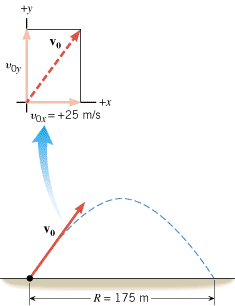
A projectile is launched from and returns to ground level, as Figure 3.22 shows. Air resistance is absent. The horizontal range of the projectile is R=175 m, and the horizontal component of the launch velocity is v0x=25 m/s. Find the vertical component v0y of the launch velocity.


A projectile, launched with a velocity whose horizontal component is

, has a range of

. From these data the vertical component v

0y
 of the initial velocity can be determined.
Figure 3.22  A projectile, launched with a velocity whose horizontal component is , has a range of . From these data the vertical component v 0y of the initial velocity can be determined.

Concept Questions and Answers What is the final value of the horizontal component vx of the projectile’s velocity?

Answer   The final value vx of the horizontal component of the projectile’s velocity is the same as the initial value in the absence of air resistance. In other words, the horizontal motion occurs at a constant velocity of 25 m/s.

Can the time be determined for the horizontal part of the motion?

Answer   Yes. In constant-velocity motion, the time is just the horizontal distance (the range) divided by the magnitude of the horizontal component of the projectile’s velocity.

Is the time for the horizontal part of the motion the same as the time for the vertical part of the motion?

Answer   Yes. The value for the time calculated for the horizontal part of the motion can be used to analyze the vertical part of the motion.

For the vertical part of the motion, what is the displacement of the projectile?

Answer   Since the projectile is launched from and returns to ground level, the vertical displacement is zero.

Solution From the constant-velocity horizontal motion, we find that the time is

For the vertical part of the motion, we know that the displacement is zero and that the acceleration due to gravity is –9.80 m/s2, assuming that upward is the positive direction. Therefore, we can use Equation 3.5b to find the initial y component of the velocity:

At the end of the problem set for this chapter, you will find homework problems that contain both conceptual and quantitative parts. These problems are grouped under the heading Concepts & Calculations, Group Learning Problems. They are designed for use by students working alone or in small learning groups. The conceptual part of each problem provides a convenient focus for group discussions.


Copyright © 2000-2003 by John Wiley & Sons, Inc. or related companies. All rights reserved.