 ×103 m has the advantage of indicating that the distance is known to four significant figures.
Appendix B. Significant Figures
The number of significant figures in a number is the number of digits whose values are known with certainty. For instance, a person’s height is measured to be 1.78 m, with the measurement error being in the third decimal place. All three digits are known with certainty, so that the number contains three significant figures. If a zero is given as the last digit to the right of the decimal point, the zero is presumed to be significant. Thus, the number 1.780 m contains four significant figures. As another example, consider a distance of 1500 m. This number contains only two significant figures, the one and the five. The zeros immediately to the left of the unexpressed decimal point are not counted as significant figures. However, zeros located between significant figures are significant, so a distance of 1502 m contains four significant figures.
Scientific notation is particularly convenient from the point of view of significant figures. Suppose it is known that a certain distance is fifteen hundred meters, to four significant figures. Writing the number as 1500 m presents a problem because it implies that only two significant figures are known. In contrast, the scientific notation of 1.500×10³ m has the advantage of indicating that the distance is known to four significant figures.
When two or more numbers are used in a calculation, the number of significant figures in the answer is limited by the number of significant figures in the original data. For instance, a rectangular garden with sides of 9.8 m and 17.1 m has an area of (9.8 m)(17.1 m). A calculator gives 167.58 m2 for this product. However, one of the original lengths is known only to two significant figures, so the final answer is limited to only two significant figures and should be rounded off to 170 m2. In general, when numbers are multiplied or divided, the number of significant figures in the final answer equals the smallest number of significant figures in any of the original factors.
The number of significant figures in the answer to an addition or a subtraction is also limited by the original data. Consider the total distance along a biker’s trail that consists of three segments with the distances shown as follows:
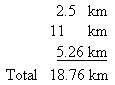 | |
The distance of 11 km contains no significant figures to the right of the decimal point. Therefore, neither does the sum of the three distances, and the total distance should not be reported as 18.76 km. Instead, the answer is rounded off to 19 km. In general, when numbers are added or subtracted, the last significant figure in the answer occurs in the last column (counting from left to right) containing a number that results from a combination of digits that are all significant. In the answer of 18.76 km, the eight is the sum of 2+1+5, each digit being significant. However, the seven is the sum of 5+0+2, and the zero is not significant, since it comes from the 11-km distance, which contains no significant figures to the right of the decimal point.
|