Additional Problems |

| |||
|
| 87 |
ssm In preparation for this problem, review Conceptual Example 7. A space traveler whose mass is 115 kg leaves earth. What are his weight and mass (a) on earth and (b) in interplanetary space where there are no nearby planetary objects?
| |
|
| 88 |
A person, sunbathing on a warm day, is lying horizontally on the deck of a boat. Her mass is 59 kg, and the coefficient of static friction between the deck and her is 0.70. Assume that the person is moving horizontally, and that the static frictional force is the only force acting on her in this direction. (a) What is the magnitude of the static frictional force when the boat moves with a constant velocity of +8.0 m/s? (b) The boat speeds up with an acceleration of 1.6 m/s2, and she does not slip with respect to the deck. What is the magnitude of the static frictional force that acts on her? (c) What is the magnitude of the maximum acceleration the boat can have before she begins to slip relative to the deck?
| |
|
| 89 |
ssm A rocket blasts off from rest and attains a speed of 45 m/s in 15 s. An astronaut has a mass of 57 kg. What is the astronaut’s apparent weight during takeoff ?
| |
|
| 90 |
Interactive LearningWare 4.4 at provides a review of the concepts that are important in this problem. A rocket of mass
 is in flight. Its thrust is directed at an angle of 55.0° above the horizontal and has a magnitude of is in flight. Its thrust is directed at an angle of 55.0° above the horizontal and has a magnitude of  . Find the magnitude and direction of the rocket’s acceleration. Give the direction as an angle above the horizontal. . Find the magnitude and direction of the rocket’s acceleration. Give the direction as an angle above the horizontal. | |
|
| 91 |
ssm A 20.0-kg sled is being pulled across a horizontal surface at a constant velocity. The pulling force has a magnitude of 80.0 N and is directed at an angle of 30.0° above the horizontal. Determine the coefficient of kinetic friction.
| |
|
| 92 |
Concept Simulation 4.1 at reviews the concepts that are important in this problem. The speed of a bobsled is increasing because it has an acceleration of 2.4 m/s2. At a given instant in time, the forces resisting the motion, including kinetic friction and air resistance, total 450 N. The mass of the bobsled and its riders is 270 kg. (a) What is the magnitude of the force propelling the bobsled forward? (b) What is the magnitude of the net force that acts on the bobsled?
| |
|
| 93 |
A
 lunar landing craft is about to touch down on the surface of the moon, where the acceleration due to gravity is 1.60 m/s2. At an altitude of 165 m the craft’s downward velocity is 18.0 m/s. To slow down the craft, a retrorocket is firing to provide an upward thrust. Assuming the descent is vertical, find the magnitude of the thrust needed to reduce the velocity to zero at the instant when the craft touches the lunar surface. lunar landing craft is about to touch down on the surface of the moon, where the acceleration due to gravity is 1.60 m/s2. At an altitude of 165 m the craft’s downward velocity is 18.0 m/s. To slow down the craft, a retrorocket is firing to provide an upward thrust. Assuming the descent is vertical, find the magnitude of the thrust needed to reduce the velocity to zero at the instant when the craft touches the lunar surface. | |
|
| 94 |
A woman stands on a scale in a moving elevator. Her mass is 60.0 kg, and the combined mass of the elevator and scale is an additional 815 kg. Starting from rest, the elevator accelerates upward. During the acceleration, the hoisting cable applies a force of 9410 N. What does the scale read during the acceleration?
| |
|
| 95 |
ssm When a 58-g tennis ball is served, it accelerates from rest to a speed of 45 m/s. The impact with the racket gives the ball a constant acceleration over a distance of 44 cm. What is the magnitude of the net force acting on the ball?
| |
|
| 96 |
A person in a kayak starts paddling, and it accelerates from 0 to 0.60 m/s in a distance of 0.41 m. If the combined mass of the person and the kayak is 73 kg, what is the magnitude of the net force acting on the kayak?
| |
|
| 97 |
The mass of a robot is 5450 kg. This robot weighs 3620 N more on planet A than it does on planet B. Both planets have the same radius of
 . What is the difference . What is the difference  in the masses of these planets? in the masses of these planets? | |
|
| 98 |
The drawing (not to scale) shows one alignment of the sun, earth, and moon. The gravitational force  that the sun exerts on the moon is perpendicular to the force that the earth exerts on the moon. The masses are: that the sun exerts on the moon is perpendicular to the force that the earth exerts on the moon. The masses are:  , ,  , ,  . The distances shown in the drawing are . The distances shown in the drawing are  and and  . Determine the magnitude of the net gravitational force on the moon. . Determine the magnitude of the net gravitational force on the moon.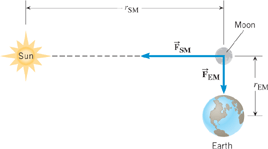 | |
|
| * | 99 |
ssm Two objects (45.0 and 21.0 kg) are connected by a massless string that passes over a massless, frictionless pulley. The pulley hangs from the ceiling. Find (a) the acceleration of the objects and (b) the tension in the string.
|
|
| * | 100 |
The central ideas in this problem are reviewed in Multiple-Concept Example 9. One block rests upon a horizontal surface. A second identical block rests upon the first one. The coefficient of static friction between the blocks is the same as the coefficient of static friction between the lower block and the horizontal surface. A horizontal force is applied to the upper block, and its magnitude is slowly increased. When the force reaches 47.0 N, the upper block just begins to slide. The force is then removed from the upper block, and the blocks are returned to their original configuration. What is the magnitude of the horizontal force that should be applied to the lower block, so that it just begins to slide out from under the upper block?
|
|
| * | 101 |
A skier is pulled up a slope at a constant velocity by a tow bar. The slope is inclined at 25.0° with respect to the horizontal. The force applied to the skier by the tow bar is parallel to the slope. The skier’s mass is 55.0 kg, and the coefficient of kinetic friction between the skis and the snow is 0.120. Find the magnitude of the force that the tow bar exerts on the skier.
|
|
| * | 102 |
A mountain climber, in the process of crossing between two cliffs by a rope, pauses to rest. She weighs 535 N. As the drawing shows, she is closer to the left cliff than to the right cliff, with the result that the tensions in the left and right sides of the rope are not the same. Find the tensions in the rope to the left and to the right of the mountain climber. 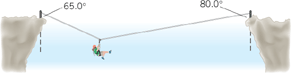 |
|
| * | 103 |
ssm To hoist himself into a tree, a 72.0-kg man ties one end of a nylon rope around his waist and throws the other end over a branch of the tree. He then pulls downward on the free end of the rope with a force of 358 N. Neglect any friction between the rope and the branch, and determine the man’s upward acceleration.
|
|
| * | 104 |
Multiple-Concept Example 17 reviews the basic concepts involved in this problem. A sports car is accelerating up a hill that rises 18° above the horizontal. The coefficient of static friction between the wheels and the road is
 . It is the static frictional force that propels the car forward. (a) What is the magnitude of the maximum acceleration that the car can have? (b) What is the magnitude of the maximum acceleration if the car is being driven down the hill? . It is the static frictional force that propels the car forward. (a) What is the magnitude of the maximum acceleration that the car can have? (b) What is the magnitude of the maximum acceleration if the car is being driven down the hill? |
|
| * | 105 |
A space probe has two engines. Each generates the same amount of force when fired, and the directions of these forces can be independently adjusted. When the engines are fired simultaneously and each applies its force in the same direction, the probe, starting from rest, takes 28 s to travel a certain distance. How long does it take to travel the same distance, again starting from rest, if the engines are fired simultaneously and the forces that they apply to the probe are perpendicular?
|
|
| * | 106 |
Jupiter is the largest planet in our solar system, having a mass and radius that are, respectively, 318 and 11.2 times that of earth. Suppose that an object falls from rest near the surface of each planet and that the acceleration due to gravity remains constant during the fall. Each object falls the same distance before striking the ground. Determine the ratio of the time of fall on Jupiter to that on earth.
|
|
| * | 107 |
ssm A person is trying to judge whether a picture (mass = 1.10 kg) is properly positioned by temporarily pressing it against a wall. The pressing force is perpendicular to the wall. The coefficient of static friction between the picture and the wall is 0.660. What is the minimum amount of pressing force that must be used?
|
|
| ** | 108 |
As part a of the drawing shows, two blocks are connected by a rope that passes over a set of pulleys. One block has a weight of 412 N, and the other has a weight of 908 N. The rope and the pulleys are massless and there is no friction. (a) What is the acceleration of the lighter block? (b) Suppose that the heavier block is removed, and a downward force of 908 N is provided by someone pulling on the rope, as part b of the drawing shows. Find the acceleration of the remaining block. (c) Explain why the answers in (a) and (b) are different. 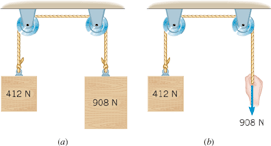 |
|
| ** | 109 |
ssm The drawing shows three objects. They are connected by strings that pass over massless and frictionfree pulleys. The objects move, and the coefficient of kinetic friction between the middle object and the surface of the table is 0.100. (a) What is the acceleration of the three objects? (b) Find the tension in each of the two strings. 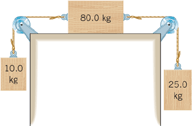 |
|
| ** | 110 |
The basic concepts in this problem are presented in Multiple-Concept Example 9. A 225-kg crate rests on a surface that is inclined above the horizontal at an angle of 20.0°. A horizontal force (magnitude = 535 N and parallel to the ground, not the incline) is required to start the crate moving down the incline. What is the coefficient of static friction between the crate and the incline?
|
|
| ** | 111 |
While moving in, a new homeowner is pushing a box across the floor at a constant velocity. The coefficient of kinetic friction between the box and the floor is 0.41. The pushing force is directed downward at an angle
 below the horizontal. When is greater than a certain value, it is not possible to move the box, no matter how large the pushing force is. Find that value of . below the horizontal. When is greater than a certain value, it is not possible to move the box, no matter how large the pushing force is. Find that value of . |
|
|
| Copyright © 2007 John Wiley & Sons, Inc. All rights reserved. |