| Newton’s Third Law of Motion |
|
|  |
Imagine you are in a football game. You line up facing your opponent, the ball is snapped, and the two of you crash together. No doubt, you feel a force. But think about your opponent. He too feels something, for while he is applying a force to you, you are applying a force to him. In other words, there isn’t just one force on the line of scrimmage; there is a pair of forces. Newton was the first to realize that all forces occur in pairs and there is no such thing as an isolated force, existing all by itself. His third law of motion deals with this fundamental characteristic of forces.
| Newton’s Third Law of Motion |
| Whenever one body exerts a force on a second body, the second body exerts an oppositely directed force of equal magnitude on the first body. |
The third law is often called the “action–reaction” law, because it is sometimes quoted as follows: “For every action (force) there is an equal, but opposite, reaction.”
Figure 4-7 illustrates how the third law applies to an astronaut who is drifting just outside a spacecraft and who pushes on the spacecraft with a force

. According to the third law, the spacecraft pushes back on the astronaut with a force

that is equal in magnitude but opposite in direction. In Example 4, we examine the accelerations produced by each of these forces.

| Example 4 | | | The Accelerations Produced by Action and Reaction Forces |
|
Suppose that the mass of the spacecraft in Figure 4-7 is mS = 11 000 kg and that the mass of the astronaut is mA = 92 kg. In addition, assume that the astronaut exerts a force of  on the spacecraft. Find the accelerations of the spacecraft and the astronaut.
Reasoning According to Newton’s third law, when the astronaut applies the force to the spacecraft, the spacecraft applies a reaction force  to the astronaut. As a result, the spacecraft and the astronaut accelerate in opposite directions. Although the action and reaction forces have the same magnitude, they do not create accelerations of the same magnitude, because the spacecraft and the astronaut have different masses. According to Newton’s second law, the astronaut, having a much smaller mass, will experience a much larger acceleration. In applying the second law, we note that the net force acting on the spacecraft is  , while the net force acting on the astronaut is  .
Solution Using the second law, we find that the acceleration of the spacecraft is
The acceleration of the astronaut is
|
 |
Problem solving insight Even though the magnitudes of the action and reaction forces are always equal, these forces do not necessarily produce accelerations that have equal magnitudes, since each force acts on a different object that may have a different mass. |

|
Test your understanding of the material in Sections 4.1, 4.2, 4.3, 4.4 and 4.5:
|
· | Newton’s First Law | |
· | Newton’s Second Law | |
· | Newton’s Third Law | |
|
|
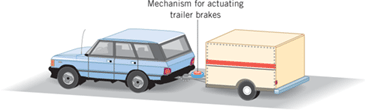
The physics of automatic trailer brakes. |
|
| Copyright © 2007 John Wiley & Sons, Inc. All rights reserved. |



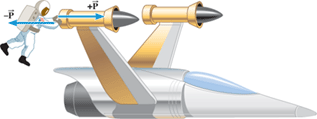
 . According to Newton’s third law, the spacecraft simultaneously pushes back on the astronaut with a force
  .
.