Forces are often applied by means of cables or ropes that are used to pull an object. For instance, Figure
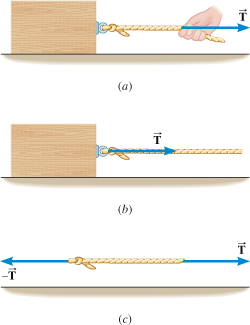
4.25a shows a force

being applied to the right end of a rope attached to a box. Each particle in the rope in turn applies a force to its neighbor.
As a result, the force is applied to the box, as part
b of the drawing shows.
 |
|
|
|
|

|
Figure 4.25 |
|
|
(a)
|
A force is being applied to the right end of a rope.
|
|
|
(b)
|
The force is transmitted to the box.
|
|
|
(c)
|
Forces are applied to both ends of the rope. These forces have equal magnitudes and opposite directions.
|
|
|
|
|
|
|
In situations such as that in Figure
4.25, we say that the force
is applied to the box because of the tension in the rope, meaning that the tension and the force applied to the box have
the same magnitude. However, the word “tension” is commonly used to mean the tendency of the rope to be pulled apart. To see
the relationship between these two uses of the word “tension,” consider the left end of the rope, which applies the force
to the box. In accordance with Newton's third law, the box applies a reaction force to the rope. The reaction force has the
same magnitude as
but is oppositely directed. In other words, a force -
acts on the left end of the rope. Thus, forces of equal magnitude act on opposite ends of the rope, as in Figure
4.25c, and tend to pull it apart.
In the previous discussion, we have used the concept of a “massless” rope (
m = 0 kg) without saying so. In reality, a massless rope does not exist, but it is useful as an idealization when applying
Newton's second law. According to the second law, a net force is required to accelerate an object that has mass. In contrast,
no net force is needed to accelerate a massless rope, since

and
m = 0 kg. Thus, when a force
is applied to one end of a massless rope, none of the force is needed to accelerate the rope. As a result, the force
is also applied undiminished to the object attached at the other end, as we assumed in Figure
4.25.
* If the rope had mass, however, some of the force
would have to be used to accelerate the rope. The force applied to the box would then be less than
, and the tension would be different at different locations along the rope. In this text we will assume that a rope connecting
one object to another is massless, unless stated otherwise. The ability of a massless rope to transmit tension undiminished
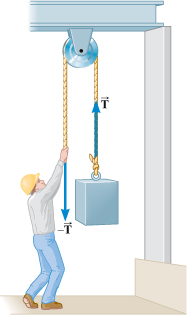
from one end to the other is not affected when the rope passes around objects such as the pulley in Figure
4.26 (provided the pulley itself is massless and frictionless).
|
|
|
|
|
|
|
Figure 4.26 |
The force applied at one end of a massless rope is transmitted undiminished to the other end, even when the rope bends around a pulley,
provided the pulley is also massless and friction is absent.
|
|
|
|
|