
|
| 2-2 | | Position and Displacement Along a Line |
|
 | | Constant Velocity |
Defining a Coordinate System
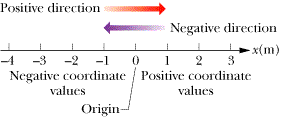
In order to study motion along a straight line, we must be able to specify the location of an object and how it changes over time. A convenient way to locate a point of interest or an object is to define a coordinate system. Houses in Costa Rican towns are commonly located with addresses such as “200 meters east of the Post Office.” In order to locate a house, a distance scale must be agreed upon (meters are used in the example), and a reference point or origin (in this case the Post Office), and a direction (in this case east) must be specified. Thus, in locating an object that can move along a straight line, it is convenient to specify its position by choosing a one-dimensional coordinate system. The system consists of a point of reference known as the origin (or zero point), a line that passes through the chosen origin called a coordinate axis, one direction along the coordinate axis, chosen as positive and the other direction as negative, and the units we use to measure a quantity. We have labeled the coordinate axis as the x saxis, in Fig.
|
 |
|
| Figure 2-1 Position is determined on an axis that is marked in units of meters and that extends indefinitely in opposite directions. |
Figure
Good choices make describing a situation much easier. For example, in our consideration of motion along a straight line, we would want to align the axis of our one-dimensional coordinate system along the line of motion. In Chapters
Defining Position as a Vector Quantity
The reason for choosing our standard one-dimensional coordinate axis and orienting it along the direction of motion is to be able to define the position of an object relative to our chosen origin, and then be able to keep track of how its position changes as the object moves. It turns out that the position of an object relative to a coordinate system can be described by a mathematical entity known as a vector. This is because, in order to find the position of an object, we must specify both how far and in which direction the object is from the origin of a coordinate system.
| |
| | A VECTOR is a mathematical entity that has both a magnitude and a direction. Vectors can be added, subtracted, multiplied, and transformed according to well-defined mathematical rules. |
There are other physical quantities that also behave like vectors such as velocity, acceleration, force, momentum, and electric and magnetic fields.
However, not all physical quantities that have signs associated with them are vectors. For example, temperatures do not need to be described in terms of a coordinate system, and single numbers, such as T = –5°C or T = 12°C, are sufficient to describe them. The minus sign, in this case, does not signify a direction. Mass, distance, length, area, and volume also have no directions associated with them and, although their values depend on the units used to measure them, their values do not depend on the orientation of a coordinate system. Such quantities are called scalars.
| |
| | A SCALAR is defined as a mathematical quantity whose value does not depend on the orientation of a coordinate system and has no direction associated with it. |
In general, a one-dimensional vector can be represented by an arrow. The length of the arrow, which is inherently positive, represents the magnitude of the vector and the direction in which the arrow points represents the direction associated with the vector.
We begin this study of motion by introducing you to the properties of one dimensional position and displacement vectors and some of the formal methods for representing and manipulating them. These formal methods for working with vectors will prove to be very useful later when working with two- and three-dimensional vectors.
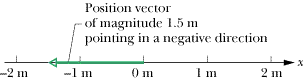
A one-dimensional position vector is defined by the location of the origin of a chosen one-dimensional coordinate system and of the object of interest. The magnitude of the position vector is a scalar that denotes the distance between the object and the origin. For example, an object that has a position vector of magnitude 5 m could be located at the point +5 m or –5 m from the origin.
On a conventional x axis, the direction of the position vector is positive when the object is located to the right of the origin and negative when the object is located to the left of the origin. For example, in the system shown in Fig.
|
 |
|
| Figure 2-2 A position vector can be represented by an arrow pointing from the origin of a chosen coordinate system to the location of the object. |
Instead of using an arrow, a position vector can be represented mathematically. In order to develop a useful mathematical representation we need to define a unit vector associated with our x axis.
| |
| | A UNIT VECTOR FOR A COORDINATE AXIS is a dimensionless vector that points in the direction along a coordinate axis that is chosen to be positive. |
It is customary to represent a unit vector that points along the positive x axis with the symbol  (i-hat), although some texts use the symbol
  (x-hat) instead. When considering three-dimensional vectors, the unit vectors pointing along the designated positive y axis and z axis are denoted by
  and
and  , respectively.
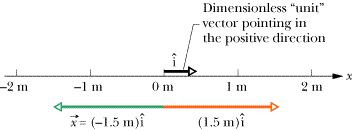
These vectors are called “unit vectors” because they have a dimensionless value of one. However, you should not confuse the use of word “unit” with a physical unit. Unit vectors should be shown on coordinate axes as small pointers with no physical units, such as meters, associated with them. This is shown in Fig.  . However, the vector we want to create points in the negative direction, so the vector pointing in the positive direction must be inverted using a minus sign. The position vector we have created is denoted as
  . It can be divided into two parts—a vector component and a unit vector,
 |
|
 |
|
Figure 2-3 Arrows representing: (1) a dimensionless unit vector,  , pointing in the positive x direction; (2) a vector representing the unit vector multiplied by 1.5 meters; and (3) a vector multiplied by 1.5 meters and inverted by multiplication by –1 to create the position vector , pointing in the positive x direction; (2) a vector representing the unit vector multiplied by 1.5 meters; and (3) a vector multiplied by 1.5 meters and inverted by multiplication by –1 to create the position vector  . This position vector has a magnitude of 1.5 meters and points in a negative direction. . This position vector has a magnitude of 1.5 meters and points in a negative direction. |
In this example, the x-component of the position vector, denoted as x, is –1.5 m.
Here the quantity 1.5 m with no minus sign in front of it is known as the magnitude of this position vector. In general, the magnitude is denoted as  . Thus, the one-dimensional position vector for the situation shown in Fig.
 |
The x-component of a position vector, denoted x, can be positive or negative depending on which side of the origin the particle is. Thus, in one dimension in terms of absolute values, the vector component x is either  or
or  , depending on the object's location.
In general, a component of a vector along an axis, such as x in this case, is not a scalar since our x-component will change sign if we choose to reverse the orientation of our chosen coordinate system. In contrast, the magnitude of a position vector is always positive, and it only tells us how far away the object is from the origin, so the magnitude of a vector is always a scalar quantity. The sign of the component (+ or –) tells us in which direction the vector is pointing.The sign will be negative if the object is to the left of the origin and positive if it is to the right of the origin.
Defining Displacement as a Vector Quantity
The study of motion is primarily about how an object's location changes over time under the influence of forces. In physics the concept of change has an exact mathematical definition.
| |
| | CHANGE is defined as the difference between the state of a physical system (typically called the final state) and its state at an earlier time (typically called the initial state). |
This definition of change is used to define displacement.
| |
| | DISPLACEMENT is defined as the change of an object's position that occurs during a period of time. |
Since position can be represented as a vector quantity, displacement is the difference between two vectors, and thus, is also a vector. So, in the case of motion along a line, an object moving from an “initial” position  to another “final” position
  at a later time is said to undergo a displacement
  , given by the difference of two position vectors
 | | |
 is given by
  because we have chosen to define it that way.
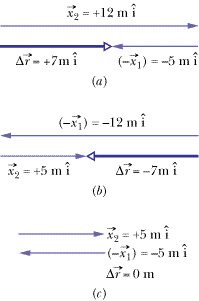
As you will see when we begin to work with vectors in two and three dimensions, it is convenient to consider subtraction as the addition of one vector to another that has been inverted by multiplying the vector component by –1. We can use this idea of defining subtraction as the addition of an inverted vector to find displacements. Let's consider three situations:
(a) |
A particle moves along a line from
| |
(b) |
A particle moves from
| |
(c) |
A particle starts at 5 m, moves to 2 m, and then returns to 5 m. The displacement for the full trip is given by
|
|
 |
|
Figure 2-4 The wide arrow shows the displacement vector  for three situations leading to: (a) a positive displacement, (b) a negative displacement, and (c) zero displacement. for three situations leading to: (a) a positive displacement, (b) a negative displacement, and (c) zero displacement. |
If we ignore the sign of a particle's displacement (and thus its direction), we are left with the magnitude of the displacement. This is the distance between the original and final positions and is always positive. It is important to remember that displacement (or any other vector) has not been completely described until we state its direction.
We use the notation  for displacement because when we have motion in more than one dimension, the notation for the position vector is
  . For a one-dimensional motion along a straight line, we can also represent the displacement as
  . The magnitude of displacement is represented by surrounding the displacement vector symbol with absolute value signs:
 |
| | |
| Can a particle that moves from one position with a negative value, to another position with a negative value, undergo a positive displacement? | |
|  | |
| TOUCHSTONE EXAMPLE 2-1: Displacements |
|
|
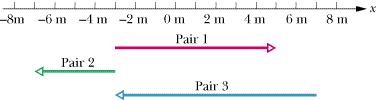
Three pairs of initial and final positions along an x axis represent the location of objects at two successive times: (pair 1) –3 m, +5 m; (pair 2) –3 m, –7 m; (pair 3) 7 m, –3 m.
(a) Which pairs give a negative displacement? SOLUTION: The Key Idea here is that the displacement is negative when the final position lies to the left of the initial position. As shown in Fig.
For pair 2 the situation is different. The final position, –7 m, lies to the left of the initial position,–3 m, so the displacement is negative. (Answer) For pair 3 the final position, –3 m, is to the left of the origin while the initial position, +7 m, is to the right of the origin. So the displacement is from the right of the origin to its left, a negative displacement. (Answer)
| |||||||||||||||||||
|
|
 to
to  . Since
  ,
,
 to
to  . Since
  ,
,
 , where
  and
and  :
:

 and the initial position is
  , so the


 —appears in all three pairs. The remaining three positions are
  ,
,  , and
, and  . The Key Idea here is that the magnitude of a position
  is 3 m to the left of the origin. It's not –3 m, because magnitudes only specify distance from the origin, not direction.
 , where
  (with the arrow over it) is the vector itself and x (with no arrow over it) is the component of the vector in the direction specified by the
  . So the component of
  is –3 m, while that of
  is just +5 m, and
  has as its component along the
  direction (–7 m) while for
  it's just (+7 m). In other words, the component of a vector in the direction of
  is just the signed number (with its units) that multiplies
  . (Answer)