| Additional Problems |
 |
| Additional Problems |
|
| 42. Kids in the Back! An unrestrained child is playing on the front seat of a car that is traveling in a residential neighborhood at 35 km/h. (How many mi/h is this? Is this car going too fast?) A small dog runs across the road and the driver applies the brakes, stopping the car quickly and missing the dog. Estimate the speed with which the child strikes the dashboard, presuming that the car stops before the child does so. Compare this speed with that of the world-record 100 m dash, which is run in about 10 s. |
| 43. The Passat GLX Test results (Car & Driver, February 1993, p. 48) on a Volkswagen Passat GLX show that when the brakes are fully applied it has an average braking acceleration of magnitude 8.9 m/s2. If a preoccupied driver who is moving at a speed of 42 mph looks up suddenly and sees a stop light 30 m in front of him, will he have sufficient time to stop? The weight of the Volkswagen is 3 152 lb. | |
| ||||||||||||
44.
Velocity and Pace When we drive a car we usually describe our motion in terms of speed or velocity. A speed limit, such as 60 mi/h, is a speed. When runners or joggers describe their motion, they often do so in terms of a pace—how long it takes to go a given distance. A 4–min mile (or better,“4 minutes/mile”) is an example of a pace.
|
| 45. Spirit of America The 9000 lb Spirit of America (designed to be the world's fastest car) accelerated from rest to a final velocity of 756 mph in a time of 45 s.What would the acceleration have been in meters per second? What distance would the driver, Craig Breedlove, have covered? | |
| ||||||||||||
| 46. Driving to New York You and a friend decide to drive to New York from College Park, Maryland (near Washington, D.C.) on Saturday over the Thanksgiving break to go to a concert with some friends who live there. You figure you have to reach the vicinity of the city at 5 P.M. in order to meet your friends in time for dinner before the concert. It's about 220 mi from the entrance to Route 95 to the vicinity of New York City.You would like to get on the highway about noon and stop for a bite to eat along the way.What does your average velocity have to be? If you keep an approximately constant speed (not a realistic assumption!), what should your speedometer read while you are driving? |
| 47. NASA Internship You are working as a student intern for the National Aeronautics and Space Administration (NASA) and your supervisor wants you to perform an indirect calculation of the upward velocity of the space shuttle relative to the Earth's surface just 5.5 s after it is launched when it has an altitude of 100 m. In order to obtain data, one of the engineers has wired a streamlined flare to the side of the shuttle that is gently released by remote control after 5.5 s. If the flare hits the ground 8.5 s after it is released, what is the upward velocity of the flare (and hence of the shuttle) at the time of its release? (Neglect any effects of air resistance on the flare.) Note: Although the flare idea is fictional, the data on a typical shuttle altitude and velocity at 5.5 s are straight from NASA! | |
| ||||||||||||
| 48. Cell Phone Fight You are arguing over a cell phone while trailing an unmarked police car by 25 m; both your car and the police car are traveling at 110 km/h.Your argument diverts your attention from the police car for 2.0 s (long enough for you to look at the phone and yell, “I won't do that!”). At the beginning of that 2.0 s, the police officer begins emergency braking at 5.0 m/s2. (a) What is the separation between the two cars when your attention finally returns? Suppose that you take another 0.40 s to realize your danger and begin braking. (b) If you too brake at 5.0 m/s2, what is your speed when you hit the police car? |
49.
Reaction Distance When a driver brings a car to a stop by braking as hard as possible, the stopping distance can be regarded as the sum of a “reaction distance,” which is initial speed multiplied by the driver's reaction time, and a “braking distance,” which is the distance traveled during braking. The following table gives typical values. (a) What reaction time is the driver assumed to have? (b) What is the car's stopping distance if the initial speed is 25 m/s?
| |
| |||||||||||||||
| 50.
Tailgating In this problem we analyze the phenomenon of “tailgating” in a car on a highway at high speeds. This means traveling too close behind the car ahead of you. Tailgating leads to multiple car crashes when one of the cars in a line suddenly slows down. The question we want to answer is: “How close is too close?”
To answer this question, let's suppose you are driving on the highway at a speed of 100 km/h (a bit more than 60 mi/h). The driver ahead of you suddenly puts on his brakes. We need to calculate a number of things: how long it takes you to respond; how far you travel in that time, and how far the other car travels in that time.
|
51.
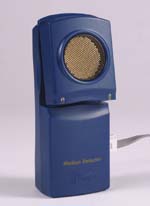
Testing the Motion Detector A motion detector that may be used in physics laboratories is shown in Fig.
|
52.
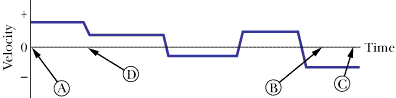
Hitting a Bowling Ball A bowling ball sits on a hard floor at a point that we take to be the origin. The ball is hit some number of times by a hammer.The ball moves along a line back and forth across the floor as a result of the hits. (See Fig.
Answer the following questions with the symbols L (left), R (right), N (neither), or C (can't say which). Each question refers only to the time interval displayed by the computer.
|
53.
Waking the Balrog In The Fellowship of the Ring, the hobbit Peregrine Took (Pippin for short) drops a rock into a well while the travelers are in the caves of Moria. This wakes a balrog (a bad thing) and causes all kinds of trouble. Pippin hears the rock hit the water 7.5 s after he drops it.
|
54.
Two Balls, Passing in the Night
|
55.
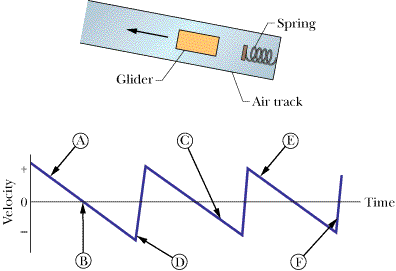
Graph for a Cart on a Tilted Airtrack—with Spring The graph in Fig.
Letters point to six points on the velocity curve. For the physical situations described below, identify which of the letters corresponds to the situation described. You may use each letter more than once, more than one letter may be used for each answer, or none may be appropriate. If none is appropriate, use the letter N.
|
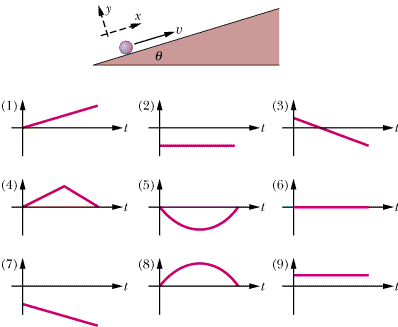
56.
Rolling Up and Down A ball is launched up a ramp by a spring as shown in Fig.
For each of the following quantities, select the letter of the graph that could provide a correct graph of the quantity for the ball in the situation shown (if the vertical axis were assigned the proper units). Use the x and y coordinates shown in the picture. If none of the graphs could work, write N.
|
| 57. Model Rocket A model rocket, propelled by burning fuel, takes off vertically. Plot qualitatively (numbers not required) graphs of y, v, and a versus t for the rocket's flight. Indicate when the fuel is exhausted, when the rocket reaches maximum height, and when it returns to the ground. | |
| ||||||||||||
58.
Rock Climber At time t = 0, a rock climber accidentally allows a piton to fall freely from a high point on the rock wall to the valley below him. Then, after a short delay, his climbing partner, who is 10 m higher on the wall, throws a piton downward. The positions y of the pitons versus t during the fall are given in Fig.
|
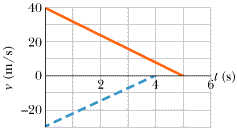
59.
Two Trains As two trains move along a track, their conductors suddenly notice that they are headed toward each other. Figure
| |
| ||||||||||||||||
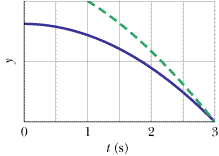
60.
Runaway Balloon As a runaway scientific balloon ascends at 19.6 m/s, one of its instrument packages breaks free of a harness and free-falls. Figure
|
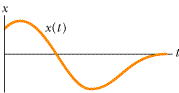
61.
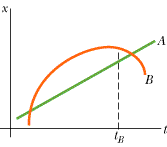
Position Function Two A particle moves along the x axis with position function x(t) as shown in Fig.
|
62.
Velocity Curve Figure
|
63.
The Motion Detector Rag This assignment is based on the Physics Pholk Song CD distributed by Pasco scientific. These songs are also available through the Dickinson College Web site at http://physics.dickinson.edu.
|
64.
Hockey Puck At time t = 0, a hockey puck is sent sliding over a frozen lake, directly into a strong wind. Figure
|
65.
Describing One-Dimensional Velocity Changes In each of the following situations you will be asked to refer to the mathematical definitions and the concepts associated with the number line. Note that being more positive is the same as being less negative, and so on.
|
66.
Bowling Ball Graph A bowling ball was set into motion on a fairly smooth level surface, and data were collected for the total distance covered by the ball at each of four times. These data are shown in the table.
|
| 67.
Modeling Bowling Ball Motion A bowling ball is set into motion on a smooth level surface, and data were collected for the total distance covered by the ball at each of four times. These data are shown in the table in Problem After using the tutorial, you can create a model for the bowling ball data given above. To do this:
|
| 68.
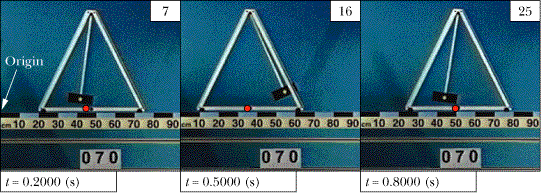
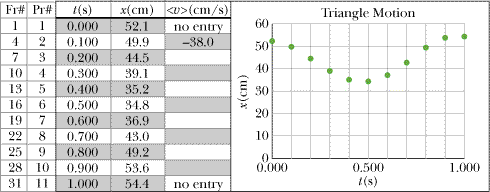
A Strange Motion After doing a number of the exercises with carts and fans on ramps, it is easy to draw the conclusion that everything that moves is moving at either a constant velocity or a constant acceleration. Let's examine the horizontal motion of a triangular frame with a pendulum at its center that has been given a push. It undergoes an unusual motion. You should determine whether or not it is moving at either a constant velocity or constant acceleration. (Note: You may want to look at the motion of the triangular frame by viewing the digital movie entitled PASCO070. This movie is included on the VideoPoint compact disk. If you are not using VideoPoint, your instructor may make the movie available to you some other way.)
The images in Fig.
Data for the position of the center of the horizontal bar of the triangle were taken every tenth of a second during its first second of motion. The origin was placed at the zero centimeter mark of a fixed meter stick.These data are in the table below.
|
69.
Cedar Point At the Cedar Point Amusement Park in Ohio, a cage containing people is moving at a high initial velocity as the result of a previous free fall. It changes direction on a curved track and then coasts in a horizontal direction until the brakes are applied. This situation is depicted in a digital movie entitled DSON002. (Note: This movie is included on the VideoPoint compact disk. If you are not using VideoPoint, your instructor may make the movie available to you some other way.)
|
70.
Three Digital Movies Three digital movies depicting the motions of four single objects have been selected for you to examine using a video-analysis program.They are as follows:
Please examine the horizontal motion of each object carefully by viewing the digital movies. In other words, just examine the motion in the x direction (and ignore any slight motions in the y direction). You may use VideoPoint, VideoGraph, or World-in-Motion digital analysis software and a spreadsheet to analyze the motion in more detail if needed. Based on what you have learned so far, there is more than one analysis method that can be used to answer the questions that follow. Note: Since we are interested only in the nature of these motions (not exact values) you do not need to scale any of the movies.Working in pixel units is fine.
|
71.
Speeding Up or Slowing Down Figure
If there is no time or time period for which a given condition exists, state that explicitly. |
72.
Right or Left Figure
If there is no time or time period for which a given condition exists, state that explicitly. |
73.
Constant Acceleration Figure
If there is no time or time period for which a given condition exists, state that explicitly. |
74.
Acceleration to the Right or Left Figure
If there is no time or time period for which a given condition exists, state that explicitly. |
|