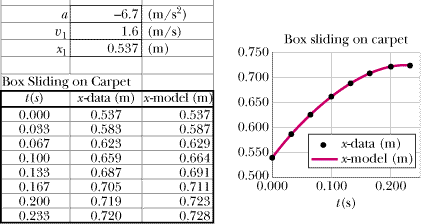
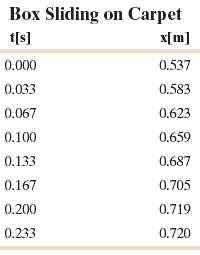
Suppose that you gave a box sitting on a carpeted floor a push and then recorded its position three times per second as it slid to a stop. The table gives the results of such a measurement. Let's analyze the position vs. time data for the box sliding on the carpet and use curve fitting and calculus to obtain the velocity measurements. We will use Excel spreadsheet software to perform our analysis, but other computer- or calculator-based fitting or modeling software can be used.
(a) Draw a graph of the x vs. t data and discuss whether the relationship appears to be linear or not.
SOLUTION: The Key Idea here is that the relationship between two variables is linear if the graph of the data points lie more or less along a straight line.There are many ways to graph the data for examination: by hand, with a graphing calculator, with a spreadsheet graphing routine, or with other graphing software such as Data Studio (available from PASCO scientific) or Graphical Analysis (available from Vernier Software and Technology). The graph in Fig. 2-18 that shows a curve and so the relationship between position, x, and time is not linear.
 | 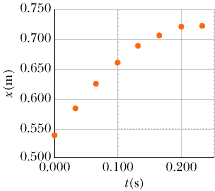 | | | Figure 2-18 Solution to Touchstone Example 2-5(a). A graph of position versus time for a box sliding across a carpet. |
|

 for each of the times in the first column using the initial position, velocity and acceleration data shown in the boxes. The line shows the model data. If the kinematic equation fits the data, then we can conclude that the acceleration component is a constant given by ax = –6.6 m/s2. Thus the acceleration is in the negative y direction.