| 3.6 |
The Chain Rule and Inverse Functions
|
 |
|
In this section we will use the chain rule to calculate the derivatives of fractional powers, logarithms, exponentials, and
the inverse trigonometric functions.5 The same method is used to obtain a formula for the derivative of a general inverse function.
Finding the Derivative of an Inverse Function: Derivative of 
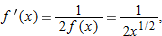
Earlier we calculated the derivative of  with
with  an integer, but we have been using the result for non-integral values of as well. We now confirm that the power rule holds for
  by calculating the derivative of
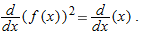
  using the chain rule. Since
the derivative of  and the derivative of
  must be equal, so
with an integer, but we have been using the result for non-integral values of as well. We now confirm that the power rule holds for by calculating the derivative of using the chain rule. Since
|
 and the derivative of must be equal, so
|
We can use the chain rule with  as the inside function to obtain:
Solving for  gives
gives
or
A similar calculation can be used to obtain the derivative of  where is a positive integer.
as the inside function to obtain:
|
 gives
gives
|
|
 where is a positive integer.
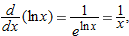
Derivative of 
We use the chain rule to differentiate an identity involving  . Since
  , we have
Solving for  gives
gives
so
. Since , we have
|
 gives
gives
|
|

|

 .
.


Derivative of 
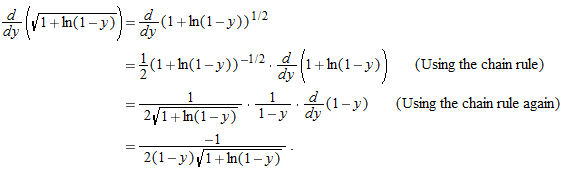
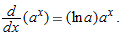
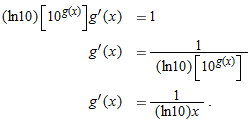
In Section 3.2, we saw that the derivative of  is proportional to . Now we see another way of calculating the constant of proportionality. We use the identity
Differentiating both sides, using  and the chain rule, and remembering that ln
  is a constant, we obtain:
Solving gives the result we obtained earlier:
is proportional to . Now we see another way of calculating the constant of proportionality. We use the identity
|
 and the chain rule, and remembering that ln is a constant, we obtain:
|

|
Derivatives of Inverse Trigonometric Functions
In Section 1.5 we defined arcsin as the angle between  and
and  (inclusive) whose sine is . Similarly,
  as the angle strictly between and whose tangent is . To find
  we use the identity
  . Differentiating using the chain rule gives
so
as the angle between and (inclusive) whose sine is . Similarly, as the angle strictly between and whose tangent is . To find we use the identity . Differentiating using the chain rule gives
|

|

Using the identity  , and replacing θ by
  , we have
Thus we have
By a similar argument, we obtain the result:
, and replacing θ by , we have
|

|

|

|

 .
.


Derivative of a General Inverse Function
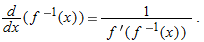
Each of the previous results gives the derivative of an inverse function. In general, if a function  has a differentiable inverse,
  , we find its derivative by differentiating
  by the chain rule:
so
Thus, the derivative of the inverse is the reciprocal of the derivative of the original function, but evaluated at the point
 instead of the point .
has a differentiable inverse, , we find its derivative by differentiating by the chain rule:
|

|
 instead of the point .
|
|||||||||||||||||||||||||||||||||||||||||||||||||||||||||||||||||||||||||||||||||||||||
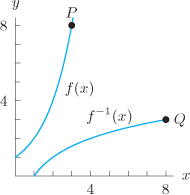


 and
and  .
.
 .
.
 .
.
 .
.

 .
.
 and
and  , so the equation of the tangent line at
 , so the slope at
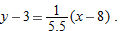
 and
and  are reflections of one another in the line
  . Thus, the two tangent lines are reflections of one another in the line
 Exercises and Problems for Section 3.6
Exercises
For Exercises 1-41, find the derivative. It may be to your advantage to simplify before differentiating. Assume  , and
, and  are constants.
, and are constants.
| 1. |
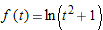   |

 .
.
| 2. |
 |
| 3. |
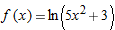 |

| 4. |
 |
| 5. |
 |

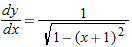 .
.
| 6. |
 |
| 7. |
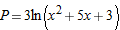 |
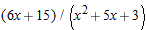
| 8. |
 |
| 9. |
 |
 , the derivative
  .
.
| 10. |
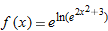 |
| 11. |
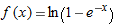 |

| 12. |
 |
| 13. |
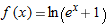 |

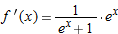 .
.
| 14. |
 |
| 15. |
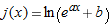 |

| 16. |
 |
| 17. |
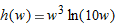 |
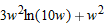
 .
.
| 18. |
 |
| 19. |
 |

| 20. |
 |
| 21. |
 |

 (because
 ), so
), so  .
.
| 22. |
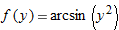 |
| 23. |
 |
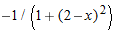
| 24. |
 |
| 25. |
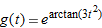 |
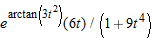
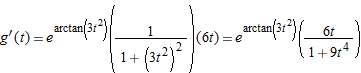 .
.
| 26. |
 |
| 27. |
 |

| 28. |
 |
| 29. |
 |

 so,
so,  .
.
| 30. |
 |
| 31. |
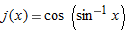 |

| 32. |
 |
| 33. |
 |


| 34. |
 |
| 35. |
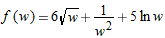 |

| 36. |
 |
| 37. |
 |

 .
.
| 38. |
 |
| 39. |
 |

| 40. |
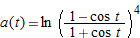 |
| 41. |
 |

 .
.
Problems
| 42. |
Let
 . .
|
 and simplify your answer.
| 43. |
On what intervals is
 concave up? concave up?
|

| 44. |
Use the chain rule to obtain the formula for
 . .
|
| 45. |
Using the chain rule, find
 . (Recall . (Recall  .) .)
|


| 46. |
To compare the acidity of different solutions, chemists use the pH (which is a single number, not the product of
 and and  ). The pH is defined in terms of the concentration, , of hydrogen ions in the solution as ). The pH is defined in terms of the concentration, , of hydrogen ions in the solution as
 |

| 47. |
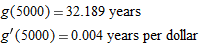
The number of years,
 , it takes an investment of $1000 to grow to , it takes an investment of $1000 to grow to  in an account which pays 5% interest compounded continuously is given by in an account which pays 5% interest compounded continuously is given by
 and and  . Give units with your answers and interpret them in terms of money in the account. . Give units with your answers and interpret them in terms of money in the account.
|

| 48. |
A firm estimates that the total revenue,
 , in dollars, received from the sale of , in dollars, received from the sale of  goods is given by goods is given by
 , is the rate of change of the total revenue as a function of quantity. Calculate the marginal revenue when , is the rate of change of the total revenue as a function of quantity. Calculate the marginal revenue when  . .
|

| 49. |
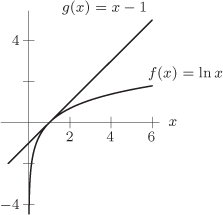
|

 , we have
  , so the slope of the tangent line is
  . The equation of the tangent line is
  , so, on the tangent line,
  .
.
 and
and  .
.
 , we have


 and
and  ? Why?
 and
and  . Similarly,
  and
and  are also below
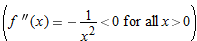
  . This is true for any approximation of this function by a tangent line since
  is concave down
  . Thus, for a given
  -value, the
  -value given by the function is always below the value given by the tangent line.
| 50. |
Find the equation of the best quadratic approximation to
 at at  . The best quadratic approximation has the same first and second derivatives as at . . The best quadratic approximation has the same first and second derivatives as at .
|
| 51. |
|
 .
.

| 52. |
Imagine you are zooming in on the graph of each of the following functions near the origin:
|
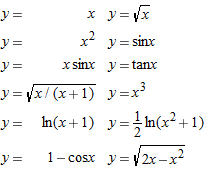
 has the given derivative.
|
||||||||
|
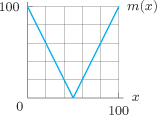
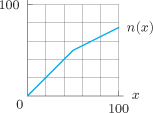
| 53. |
 |

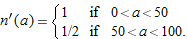
 we must find values
  and
and  and
and  .
.
 gives
gives
 gives
gives

 are 1 and
  and the only values of the derivative
  are 2 and
  . In order to have
  and
and  . Thus
  and
and  .
.
 for
for  .
.
 .
.
| 54. |
 |
| 55. |
 |

| 56. |
 |
In Problems 57-59, use Figure 3.31 to estimate the derivatives.
|
||||||||
|
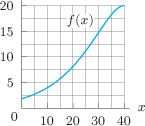
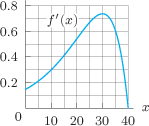
| 57. |
 |
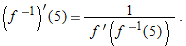
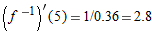
 . From the graph of
  . Thus
  .
.
| 58. |
 |
| 59. |
 |
In Problems 60-62, use Figure 3.32 to calculate the derivative.
|
||
|
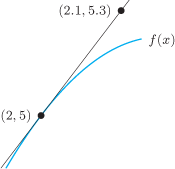
| 60. |
 if if  |
| 61. |
 if if 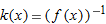 |

 . The point (2.1, 5.3) is on the tangent line, so

 .
.

| 62. |
 if if  |
| 63. |
|
 , find
 .
.

| 64. |
|
 , find
  .
.
 .
.
 .
.
| 65. |
Use the table and the fact that
is invertible and differentiable everywhere to find  . .
|
 , we first look in the table to find that
  , so
, so  . Thus,

| 66. |
At a particular location,
 is the number of gallons of gas sold when the price is dollars per gallon. is the number of gallons of gas sold when the price is dollars per gallon.
|
 tell you about gas sales?
 .
.
 tell you about gas sales?

| 67. |
|
 give the US population
 .
.
 tell you about the US population?
 . Give units.
 tell you about the population? Give units.

 . Give units.

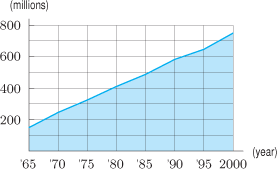
| 68. |
 , in millions, registered in the world


| 69. |
|
 ,
,  ,
,  ,
,  , find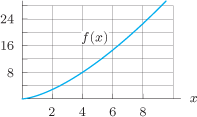

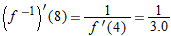
 . From the graph we see
  . Thus
  .
.
| 70. |
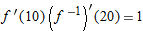
If
is increasing and  , which of the two options, (a) or (b), must be wrong? , which of the two options, (a) or (b), must be wrong?
|
 .
.
 .
.
| 71. |
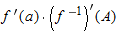
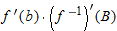
An invertible function
has values in the table. Evaluate
|


| 72. |
If
is continuous, invertible, and defined for all , why must at least one of the statements  , , 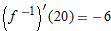 be wrong? be wrong?
|
| 73. |
|
 by identifying the limit as the derivative of
  at
at  .
.
 at
at 
 .
.

 , we have
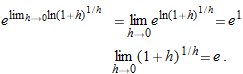
 .
.

 . Then as
  , we have
  . Since

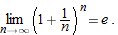
Strengthen Your Understanding
In Problems 74-76, explain what is wrong with the statement.
| 74. |
If
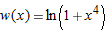 then then 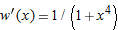 . .
|
| 75. |
The derivative of
 is is
|


| 76. |
Given
 , ,  , and , and  , we have , we have
|

In Problems 77-80, give an example of:
| 77. |
A function that is equal to a constant multiple of its derivative but that is not equal to its derivative.
|

 with
with  ,
,  and
and  is a constant multiple of its derivative but it is not equal to its derivative:
 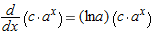 . One example is
  .
.
| 78. |
A function whose derivative is
 , where c is a constant. , where c is a constant.
|
| 79. |
A function
 for which for which  , where , where  is a constant. is a constant.
|

| 80. |
A function
such that  . .
|
Are the statements in Problems 81-82 true or false? Give an explanation for your answer.
| 81. |
The graph of
 is concave up for is concave up for  . .
|

 is negative for
 | 82. |
If
has an inverse function,  , then the derivative of is , then the derivative of is  . .
|