| Questions |
| |
| ||
|
1
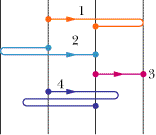
Figure 2-14 shows four paths along which objects move from a starting point to a final point, all in the same time interval. The paths pass over a grid of equally spaced straight lines. Rank the paths according to (a) the average velocity of the objects and (b) the average speed of the objects, greatest first.
| |
| |||||||||||||||||||||||
2
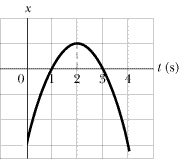
Figure 2-15 is a graph of a particle's position along an x axis versus time. (a) At time t = 0, what is the sign of the particle's position? Is the particle's velocity positive, negative, or 0 at (b) t = 1 s, (c) t = 2 s, and (d) t = 3 s? (e) How many times does the particle go through the point x = 0?
| |
| ||||||||||||||
3
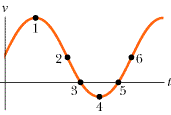
Figure 2-16 gives the velocity of a particle moving along an axis. Point 1 is at the highest point on the curve; point 4 is at the lowest point; and points 2 and 6 are at the same height. What is the direction of travel at (a) time t = 0 and (b) point 4? (c) At which of the six numbered points does the particle reverse its direction of travel? (d) Rank the six points according to the magnitude of the acceleration, greatest first.
| |
| ||||||||||||||||||||
| 4 The following equations give the velocity v(t) of a particle in four situations: (a) v = 3; (b) v = 4t2 + 2t - 6; (c) v = 3t - 4; (d) v = 5t2 - 3. To which of these situations do the equations of Table 2-1 apply? | |
| |||||||||||||||
5
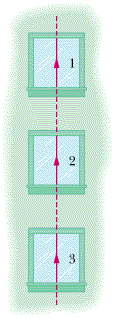
In Figure 2-17, a cream tangerine is thrown directly upward past three evenly spaced windows of equal heights. Rank the windows according to (a) the average speed of the cream tangerine while passing them, (b) the time the cream tangerine takes to pass them, (c) the magnitude of the acceleration of the cream tangerine while passing them, and (d) the change Dv in the speed of the cream tangerine during the passage, greatest first.
| |
| ||||||||||||||||||||
| 6 At t = 0, a particle moving along an x axis is at position x0 = -20 m. The signs of the particle's initial velocity v0 (at time t0) and constant acceleration a are, respectively, for four situations: (1) +, +; (2) +, -; (3) -, +; (4) -, -. In which situations will the particle (a) stop momentarily, (b) pass through the origin, and (c) never pass through the origin? | |
| |||||||||||||||
| 7 The driver of a blue car (80 km/h) suddenly realizes that she is about to rear-end a red car (60 km/h). To avoid a collision, what is the maximum speed the blue car can have just as it reaches the red car? (Warm-up for Problem 37) | |
| ||||||||||||||||||
8
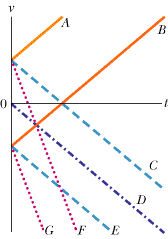
Hanging over the railing of a bridge, you drop an egg (no initial velocity) as you throw a second egg downward. Which curves in Figure 2-18 give the velocity v(t) for (a) the dropped egg and (b) the thrown egg? (Curves A and B are parallel; so are C, D, and E; so are F and G.)
| |
| ||||||||||||||
| 9 At t = 0 and x = 0, an initially stationary blue car begins to accelerate at the constant rate of 2.0 m/s2 in the positive direction of the x axis. At t = 2 s, a red car traveling in an adjacent lane and in the same direction passes x = 0 with a speed of 8.0 m/s and a constant acceleration of 3.0 m/s2. What pair of simultaneous equations should be solved to find when the red car passes the blue car? (Warm-up for Problem 63) | |
| ||||||||||||||||||
|