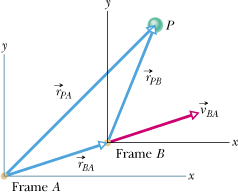
Our two observers are again watching a moving particle
P from the origins of reference frames
A and
B, while
B moves at a constant velocity

relative to
A. (The corresponding axes of these two frames remain parallel.) Figure
4-22 shows a certain instant during the motion. At that instant, the position vector of the origin of
B relative to the origin of
A is

. Also, the position vectors of particle
P are

relative to the origin of
A and

relative to the origin of
B. From the arrangement of heads and tails of those three position vectors, we can relate the vectors with
 |
| (4-43) |
|
By taking the time derivative of this equation, we can relate the velocities

and

of particle
P relative to our observers:
|
| (4-44) |
|
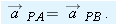
By taking the time derivative of this relation, we can relate the accelerations

and

of the particle
P relative to our observers. However, note that because
is constant, its time derivative is zero. Thus, we get
|
| (4-45) |
|
As for one-dimensional motion, we have the following rule: Observers on different frames of reference that move at constant velocity relative to each other will measure the
same acceleration for a moving particle.
| | | |  | FIGURE 4-22 | Frame B has the constant two-dimensional velocity  relative to frame A. The position vector of B relative to A is relative to frame A. The position vector of B relative to A is  . The position vectors of particle P are . The position vectors of particle P are  relative to A and relative to A and  relative to B. relative to B.
|
| |
| |
 Bulldozer on Moving Sheet




 relative to the wind, with an airspeed (speed relative to the wind) of 215 km/h, directed at angle
  south of east. The wind has velocity
  relative to the ground with speed of 65.0 km/h, directed 20.0° east of north. What is the magnitude of the velocity
  of the plane relative to the ground, and what is






 is equal to the magnitude
  . Substituting this notation and the value
  , we find


 Interactive LearningWare 4.73
 Relative Velocities