| 4.3 | Average Velocity and Instantaneous Velocity |
 |
|
If a particle moves from one point to another, we might need to know how fast it moves. Just as in Chapter
2, we can define two quantities that deal with “how fast”:
average velocity and
instantaneous velocity. However, here we must consider these quantities as vectors and use vector notation.
If a particle moves through a displacement

in a time interval

, then its
average velocity 
is
or
|
| (4-8) |
|
This tells us that the direction of
(the vector on the left side of Eq.
4-8) must be the same as that of the displacement
(the vector on the right side). Using Eq.
4-4, we can write Eq.
4-8 in vector components as
For example, if the particle in Sample Problem
4-1 moves from its initial position to its later position in 2.0 s, then its average velocity during that move is
That is, the average velocity (a vector quantity) has a component of 6.0 m/s along the
x axis and a component of 1.5 m/s along the
z axis.
When we speak of the
velocity of a particle, we usually mean the particle’s
instantaneous velocity 
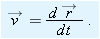
at some instant. This
is the value that
approaches in the limit as we shrink the time interval
to 0 about that instant. Using the language of calculus, we may write
as the derivative
|
| (4-10) |
|
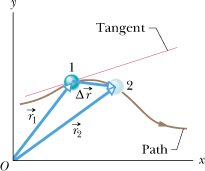
To find the instantaneous velocity of the particle at, say, instant
t1 (when the particle is at position 1), we shrink interval
to 0 about
t1. Three things happen as we do so. (1) Position vector

in Fig.
4-4 moves toward

so that
shrinks toward zero. (2) The direction of

(and thus of
) approaches the direction of the line tangent to the particle’s path at position 1. (3) The average velocity
approaches the instantaneous velocity
at
t1.
In the limit as

, we have

and, most important here,
takes on the direction of the tangent line. Thus,
has that direction as well:
The result is the same in three dimensions:
is always tangent to the particle’s path.
To write Eq.
4-10 in unit-vector form, we substitute for

from Eq.
4-1:
This equation can be simplified somewhat by writing it as
|
| (4-11) |
|
where the scalar components of
are
|
| (4-12) |
|
For example,

is the scalar component of
along the
x axis. Thus, we can find the scalar components of
by differentiating the scalar components of
.
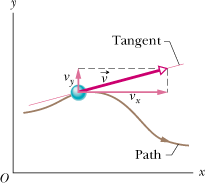
Figure
4-5 shows a velocity vector
and its scalar
x and
y components. Note that
is tangent to the particle’s path at the particle’s position.
Caution: When a position vector is drawn, as in Figs.
4-1 through
4-4, it is an arrow that extends from one point (a “here”) to another point (a “there”). However, when a velocity vector is drawn, as in Fig.
4-5, it does
not extend from one point to another. Rather, it shows the instantaneous direction of travel of a particle at the tail, and its length (representing the velocity magnitude) can be drawn to any scale.
| | | |  | FIGURE 4-5 | The velocity  of a particle, along with the scalar components of . of a particle, along with the scalar components of .
|
| |
| |
|
| | |
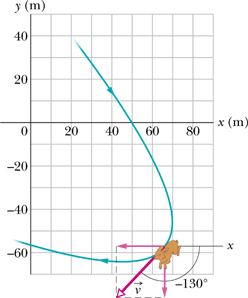
For the rabbit in Sample Problem 4-2 find the velocity at time  .
Calculations: Applying the  part of Eq. 4-12 to Eq. 4-5, we find the x component of to be
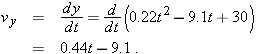
At , this gives  . Similarly, applying the  part of Eq. 4-12 to Eq. 4-6, we find
At , this gives  . Equation 4-11 then yields
which is shown in Fig. 4-6, tangent to the rabbit’s path and in the direction the rabbit is running at . | | | | | | FIGURE 4-6 | The rabbit’s velocity at  . .
|
| |
| |
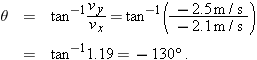
To get the magnitude and angle of , either we use a vector-capable calculator or we follow Eq. 3-6 to write
and
Check: Is the angle −130° or −130° + 180° = 50°?.
| | |
| |  | |  |
|
|
|
|
| Copyright © 2008 John Wiley & Sons, Inc. All rights reserved. |






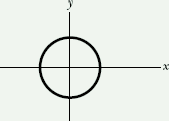
 of a particle during a time interval
  , from position 1 with position vector
  at time
  at time



 , through which quadrant is the particle moving at that instant if it is traveling (a) clockwise and (b) counterclockwise around the circle? For both cases, draw