Calculations: Applying the
ax part of Eq.
4-18 to Eq.
4-13, we find the
x component of

to be
Similarly, applying the
ay part of Eq.
4-18 to Eq.
4-14 yields the
y component as
We see that the acceleration does not vary with time (it is a constant) because the time variable
t does not appear in the expression for either acceleration component. Equation
4-17 then yields
which is superimposed on the rabbit’s path in Fig.
4-8.
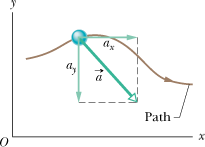
 | | | |  | FIGURE 4-8 | The acceleration  of the rabbit at of the rabbit at  . The rabbit happens to have this same acceleration at all points on its path. . The rabbit happens to have this same acceleration at all points on its path.
|
| |
| |
To get the magnitude and angle of

, either we use a vector-capable calculator or we follow Eq. 3-6. For the magnitude we have
For the angle we have
However, this angle, which is the one displayed on a calculator, indicates that
is directed to the right and downward in Fig.
4-8. Yet, we know from the components that
must be directed to the left and upward. To find the other angle that has the same tangent as −35° but is not displayed on a calculator, we add 180°:
This
is consistent with the components of
. Note that
has the same magnitude and direction throughout the rabbit’s run because the acceleration is constant.
 to
to  in a time interval
  , its average acceleration
  during
 to obtain
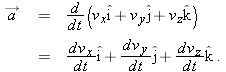


 Interactive LearningWare 4.17
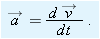



 and
and 
 and
and 

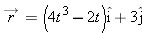


 .
.







 (in meters per second) at
  at an angle
  from the positive direction of the
  ?
? ) applies, we must apply it separately for motion parallel to the
  and
and  from the equations

 and
and 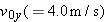 are the
  , and
, and  and
and  are the




