CHAPTER 4 Additional Sample Problems
 
Sample Problem 4-A
Two-dimensional taken from . A particle moves on a horizontal surface according to
in meters and seconds. When, if ever, is the x component of the velocity zero? The y component of the velocity zero? The magnitude of the velocity zero?
 KEY IDEA 
(1) The velocity is the derivative of the position function with respect to time. The derivative is taken component by component, and the unit-vector symbols must be retained. (2) Velocity is a vector quantity. Its magnitude is calculated by using the Pythagorean theorem with the vector components.

Calculations: Taking the time derivative of each component of , we find
with in meters per second. The x component is 3 m/s and is never zero. The y component is and is zero when . The magnitude of the velocity is
which can never be zero because the x component is always 3 and the square of the y component cannot be a negative number.

Variations:

1.  

When is the x component of the acceleration zero?
Answer: always

2.  

When is the y component of the acceleration zero?
Answer: never

3.  

When is the magnitude of the acceleration zero?
Answer: never

Sample Problem 4-B
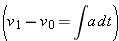
Two-dimensional taken from . A particle with velocity at undergoes acceleration while moving in an xy plane. What is the particle’s velocity at , in unit-vector notation and in magnitude-angle notation?
 KEY IDEA 
(1) Velocity can be determined from acceleration by integrating with respect to time. The integration is done with each component and the unit-vector symbols are retained. (2) The magnitude and direction of a velocity can be determined from its components.

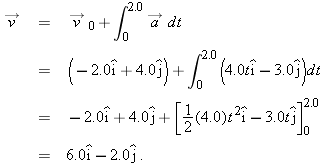
Calculations: Writing Eq. 2-22 for this situation, we have

  (Answer)

The magnitude of is

  (Answer)

The direction of is determined by the angle between and the positive direction of the x axis. We find with

  (Answer)

Drawing and its components confirms that the angle is , not .

Variations:

1.  

When, if ever, is the magnitude of the acceleration zero?
Answer: never

2.  

When, if ever, is the x velocity component zero?
Answer: 1 s and −1 s

3.  

When, if ever, is the magnitude of the velocity zero?
Answer: never

Sample Problem 4-C
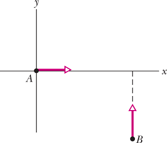
Collision in two-dimensional motion. Figure 4-C shows two particles at time . Particle A is passing through the origin with velocity , and particle B is passing through coordinates (12 m, −8.0 m) with constant velocity . What constant acceleration of A is required such that A travels along the x axis to collide with B?
Figure zoom  FIGURE 4-C   
 KEY IDEA 
(1) Because both particles move with constant acceleration (zero for B), we can use the constant acceleration equations of Chapter 2. (2) To collide, the particles must pass through the same point at the same time.

Calculations: Because A is to travel along the x axis, the collision point must be on the x axis, at coordinates (12 m, 0).To reach that point, particle B travels parallel to the y axis at constant velocity. Of the constant-acceleration equations, we choose Eq. 2-15, rewriting it for motion parallel to the y axis:
Substituting , , , and , and then solving for the time for B to reach the collision point, we find that .

For A we use the same constant-acceleration equation except we now write it for motion parallel to the x axis:
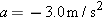
Substituting , , , and , we find that A must have an acceleration along the x axis of . Thus,

  (Answer)


Variations:

1.  

If the data are as given in the problem statement but A does not undergo an acceleration, does it arrive at the point (12 m, 0) before or after B?
Answer: before

2.  

What velocity parallel to the x axis must A have at if it is to collide with B without having to undergo an acceleration?
Answer:

Sample Problem 4-D
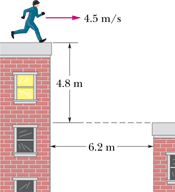
Projectile, horizontal launch. In Fig. 4-D, a movie stuntman is to run across and directly off a rooftop, to land on the roof of the next building. Can he land there if he runs at 4.5 m/s?
Figure zoom  FIGURE 4-D   
 KEY IDEA 
While in flight, the stuntman is a projectile.

Calculations: The initial velocity is horizontal () and has magnitude . For him to land on the second roof, his horizontal displacement during the flight must be at least 6.2 m. We should be able to find the actual value of for the given initial speed by using Eq. 4-21,

  (01)

but for that we need his time of flight t.

To find t, we consider the vertical motion and use Eq. 4-22:

  (02)

Here his vertical displacement during the flight is −4.8 m. Putting this and other known values into Eq. 02 gives us
which yields . Using this in Eq. 01, we have
Thus, with his given running speed, he cannot land on the roof of the next building.

Sample Problem 4-E
Determining projectile launch using mid-flight data. A particle is launched into projectile motion over level ground. At point A, 3.0 m above ground level, the particle has velocity . What was the angle between its path and the positive direction of the x axis at the launch point?
 KEY IDEA 
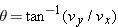
(1) Because a particle’s velocity is always tangent to the particle’s path, the direction of the path is always the direction of the velocity. (2) The direction of a velocity can be found from the velocity components with . (3) During flight, the horizontal acceleration component is zero and thus the horizontal velocity component does not change. (4) The vertical acceleration component is and thus the vertical velocity component does change. (5) The vertical motion can be considered as one-dimensional motion independent of the horizontal motion.

Calculations: Because the horizontal velocity component does not change, its value at the launch point must be the same as at point A, namely . Thus, .

Because the vertical acceleration is constant, we can use the constant-acceleration equations of Chapter 2. We use Eq. 2-16 written for y motion in the form of Eq. 4-24:

Substituting , , and , we solve for the quantity and use the positive root when taking the square root. That quantity is the vertical velocity at launch. Thus, . At launch, the velocity and the path have the angle

  (Answer)


Variations:

1.  

What is the launch speed?
Answer: 10.9 m/s

2.  

The particle is at a height of 3.0 m at one other instant during its flight. What is its velocity at that other instant?
Answer:

Sample Problem 4-F
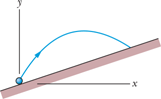
Projectile on a slope. In Fig. 4-F, a projectile is launched at speed and at angle up over sloped ground that rises 1.00 m for every horizontal 3.00 m. At what xy coordinates does the projectile land?
Figure zoom  FIGURE 4-F   
 KEY IDEA 
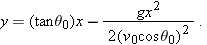
The projectile’s vertical and horizontal motions can be analyzed separately, as if they are separate one-dimensional motions. However, by eliminating time, the equations for positions y and x can be combined to yield Eq. 4-25, in which y is expressed as a function of x.

Calculations: To determine where the projectile hits the sloped ground, we first write equations y(x) for the height as a function of horizontal position, for both the projectile’s path and the ground. Then we solve the equations simultaneously for x. For the projectile, we use Eq. 4-25:

  (01)

Substituting and , this becomes

  (02)

For the hill, we write a linear equation in the form , where the slope is and the y intercept is :

  (03)

Solving Eqs. 02 and 03 simultaneously by eliminating y and then solving the resulting quadratic equation for x, we find

  (Answer)

Substituting this result into either Eq. 02 or 03 gives us

  (Answer)


Variation: If the slope of the ground is decreased, does the x coordinate of the landing point increase, decrease, or remain the same?

Answer: increase

Sample Problem 4-G
Uniform circular motion. A satellite is in circular Earth orbit, at altitude above Earth’s surface. There the free-fall acceleration g is . What is the orbital speed v of the satellite?
 KEY IDEA 
The satellite is in uniform circular motion about Earth and the centripetal acceleration is the free-fall acceleration .

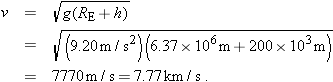
Calculations: We can find v from Eq. 4-34 , with and with , where is Earth’s radius . With those substitutions, we have
Solving for v gives

  (Answer)

You can show that this is equivalent to 28 000 km/h and that (from Eq. 4-35) the satellite would take 1.47 h to complete one orbital revolution; that is, the period T of the motion is 1.47 h.

Sample Problem 4-H
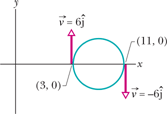
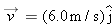
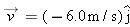
Uniform circular motion. A particle undergoes uniform circular motion on a horizontal xy plane. At time , it moves through coordinates (3.0 m, 0) with velocity . At , it moves through (11.0 m, 0) with velocity . In unit vector notation, what is its acceleration at ?
 KEY IDEA 
In uniform circular motion, a particle follows a circular path at constant speed v, has a velocity tangent to the circle, and has an acceleration directed toward the center with a magnitude given by Eq. 4-34 .

Calculations: Because the two given velocity vectors are in opposite directions, they must be on opposite sides of the circular path. Because the vectors are tangent to the circle and directed parallel to the y axis, they must be on the left side and right side of the circle. Thus at , the particle is on the left side at coordinates (3.0 m, 0), as indicated in Fig. 4-H. At , it is on the right side at coordinates (11.0 m, 0). The center of the circle must be midway between these points, at coordinates (7.0 m, 0), which means the radius is .
Figure zoom  FIGURE 4-H   

The speed is the magnitude of , which is 6.0 m/s. We then have
At , the particle is at the top of the circle, midway between the left side and the right side, and thus it must be at coordinates (7.0 m, 4.0 m). Because the acceleration vector is always directed toward the center of the circle, at it must be directed down toward (7.0 m, 0). Therefore,

  (Answer)


Variations:

1.  

What is when ?
Answer: 3.3 m/s

2.  

What is a when ?
Answer:

Sample Problem 4-I
One-dimensional relative motion. A boat moves downstream in the positive direction of an x axis. The boat’s velocity relative to the shore is , and the water’s velocity relative to the shore is . A child walks upstream from the front to the rear of the boat with a velocity of relative to the boat. What is the child’s velocity relative to the water?
 KEY IDEA 
We can attach individual frames of reference to the boat, the water, and the shore. Because these three frames move at constant velocities relative to one another, we can use velocities in a vector addition to find any given relative velocity.

Calculations: The velocity of the boat relative to the shore is , and the velocity of the water relative to the shore is . Thus, the velocity of the boat relative to the water is
where we use the fact that is the reverse of . Notice how we expand the initial subscript bw to become the subscripts bs and sw.

The velocity of the child relative to the boat is . We can now write that the velocity of the child relative to the water is

  (Answer)


Variations:

1.  

What is the velocity of the shore relative to the child?
Answer:

2.  

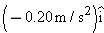
If the child accelerates at relative to the boat, what is the child’s acceleration relative to the shore?
Answer:

Sample Problem 4-J
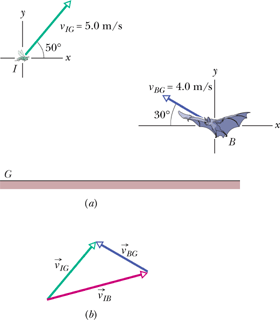
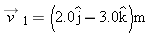
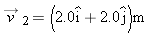
Two-dimensional relative motion. In Fig. 4-Ja, a bat detects an insect (lunch) while the two are flying. The bat has velocity relative to the ground, and the insect has velocity relative to the ground. What is the velocity of the insect relative to the bat, in unit-vector notation and as a magnitude and an angle?
Figure zoom  FIGURE 4-J   
 KEY IDEA 
We can relate these three relative velocities with a triangle like that in Fig. 4-22 and with an equation like Eq. 4-44 .

Calculations: The moving particle P is now the insect (I), frame A is now the ground (G), and frame B is now the bat (B). We first construct a sentence that relates the three vectors:
Now we can draw this relation as in Fig. 4-Jb and write it as
or
We can evaluate the right side of this last equation directly on a vector-capable calculator by keying in the given vectors. Alternatively, we can resolve the given vectors into vector components and then add and . We have
and
Thus,

  (Answer)

Using the components in the Pythagorean theorem and an inverse tangent, we find that has
and

  (Answer)

Sample Problem 4-K
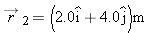
Average velocity using unit vectors. At time , a particle is located by position vector . At , it is located by . What is the particle’s average velocity in unit-vector notation and in magnitude-angle notation?
 KEY IDEA 
The average velocity is displacement divided by the elapsed time. (2) The displacement is the initial position vector subtracted from the final position vector.

Calculations: The displacement is
Dividing this by the elapsed time of 2.0 s gives us the average velocity during that time interval:

  (Answer)

To find the magnitude of the average velocity, we insert the components in the Pythagorean theorem for three dimensions, where the third component is entered as the third squared term under the square root:

  (Answer)

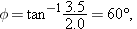
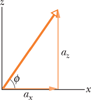
To find the orientation of the average velocity, first note that the vector lies in the xz plane (because it does not have a y component). We can draw the components in a head-to-tail arrangement as shown in Fig. 4-K. The angle relative to the positive direction of the x axis is then given by :

  (Answer)

measured counterclockwise in Fig. 4-K.
Figure zoom  FIGURE 4-K   

Sample Problem 4-L
Average acceleration using unit vectors. At time , a particle has velocity . At , it has velocity . What is the particle’s average acceleration in unit-vector notation and in magnitude-angle notation?

 KEY IDEA 
(1) The average acceleration is the change in the velocity divided by the elapsed time. (2) The change in the velocity is the initial velocity vector subtracted from the final velocity vector.

Calculations: The change in velocity is (being very careful about the unit vectors)
Dividing this by the elapsed time of 2.0 s gives us the average velocity during that time interval:

  (Answer)

To find the magnitude of the average acceleration, we insert the components in the Pythagorean theorem for three dimensions, where the third component is entered as the third squared term under the square root:

  (Answer)

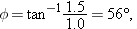
To find the orientation of the average velocity, first note that the vector lies in the xz plane (because it does not have a y component). We can draw the components in a head-to-tail arrangement as shown in Fig. 4-L. The angle relative to the positive direction of the x axis is then given by :

  (Answer)

measured counterclockwise in Fig. 4-L.
Figure zoom  FIGURE 4-L   


Copyright © 2008 John Wiley & Sons, Inc. All rights reserved.