 | The following is an excerpt from Jearl Walker's THE FLYING CIRCUS OF PHYSICS, 2nd edition. The Flying
Circus is a compendium of interesting real world phenomena that can be explained using basic laws of physics. For more
information about this text, please visit www.wiley.com/college/walker |
| 1.19 | Fear and trembling at the amusement park |
 |
|
What accounts for the thrill of a ride on a roller coaster? Surely, the heights, speeds, and illusions of falling are factors, but all those sensations can be had in a fast, exterior elevator that is glass encased. No one queues up and pays for elevator rides.
And how about the rides that sling you about? Why do you clutch, and maybe even scream, during the rides?
Roller coasters are designed to give the illusion of danger (that is part of their fun), but in fact engineers go to extreme lengths to make them exceedingly safe for riders. In spite of this attention to passenger safety, an unlucky few of the millions of people who ride roller coasters each year end up with a medical condition called roller-coaster headache. Symptoms, which might not appear for several days, include vertigo and headache, both severe enough to require medical treatment. What causes roller-coaster headache?
Answer Some rides are exciting because of heights, high speeds, or large accelerations (up to 4 gs on a roller coaster), or because rapid rotation creates an amusing sensation of centrifugal (outward-directed) force, but the most frightening rides are usually those that produce rapidly changing and unexpected forces on you. When you feel a constant force and undergo a constant acceleration, things seem under control, but when the force suddenly changes size or direction and you accelerate unexpectedly, you subconsciously sense danger. The element of surprise on a subconscious level generates an existential flirt with death.
Standard roller coaster: The heights and the high speeds are enthralling, as is the clatter on an old wooden coaster. When you travel quickly through a curved low section, an apparent centrifugal force on you seemingly presses you into the seat; when you travel over a short but highly curved hill, the force seems to throw you out of the seat. When you go over the edge of the first and largest hill, you have a distinct feeling of falling. The illusion is best when you sit in the front car so that little of the coaster is in front of you. However, I think that sitting in the rear car is even more frightening. As you approach the edge and more of the coaster begins to descend, the force on your back builds, gradually at first and then ever more rapidly (the rate is exponential), and just as you reach the edge, the force disappears. The experience is as if some diabolical agent shoves you toward the edge in a frenzy and then hurls you into free fall.
Mouse roller coasters: The cars are sent separately along the track. The compartment in which you sit pivots above a wheeled framework that follows the track, with the pivot located near the back of the car. When you reach a sharp turn, the framework faithfully follows the curved track but the compartment continues to travel forward for a moment before it too turns. In that moment you have the illusion that the compartment is flying off the track.
Modern roller coasters: Vertical loops and corkscrews produce sensations of centrifugal forces that rapidly change size and direction, and you are also turned upside down. Both factors produce fear. As you ascend a vertical loop, the apparent centrifugal force should decrease as you slow, but the curvature of the track sharply increases so as to maintain that apparent force. On some coasters you might move along the track while facing backwards so that you cannot foresee any of the changes in force, speed, or acceleration that you are about to undergo. Riding a coaster in darkness also eliminates anticipation and enhances fear.
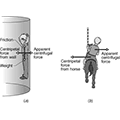
Ferris wheel, merry-go-round, and rotating swings: These rides offer milder sensations of a centrifugal force. When your cage on a Ferris wheel rotates through the top of the circle, you feel as though you are being lifted by the force. At the bottom of the circle, you feel as though you are being shoved downward into the seat. On a merry-go-round, the centrifugal force seems to throw you outward (
Fig. 1-4b), especially if you ride an outside horse, which moves faster around the circle than horses closer to the center. When you ride in a swing that is rotated around a central hub, the chains move off vertical as if a centrifugal force is pushing you outward. In each of these three rides, there really is no centrifugal force. Rather there is a centripetal force (from the seat in the Ferris wheel, the horse in the merry-go-round, and the chains in the swing), and that force is what keeps you circling.
Rides with rotating arms: You sit in a compartment that is at the outer end of an arm which pivots around the outer end of another, more central arm. If the arms rotate around their pivots in the same direction, you feel the greatest centrifugal force and have the greatest speed when you pass through a point that is farthest from the center of the apparatus. When the directions of rotation are opposite, your speed is least at the far point (due to the opposing rotations), but the force on you varies most rapidly there because you are being whipped through a highly curved path.
Vertical falls: You sit in a compartment that is some 40 meters high when it is suddenly released and allowed to drop in almost free fall. You have a sense of weightlessness because you and the seat below you fall at almost the same rate, and so you no longer feel any support from the seat. Some riders think that the sensation is fun.
Roller-coaster headache can result from any amusement park ride in which the acceleration is large and rapidly changing in direction. The large acceleration puts a strain on the brain and any abrupt change in direction can then cause the brain to move relative to the skull, tearing the veins that bridge the brain and skull.
|
| Copyright © 2007 John Wiley & Sons, Inc. All rights reserved. |