 | The following is an excerpt from Jearl Walker's THE FLYING CIRCUS OF PHYSICS, 2nd edition. The Flying
Circus is a compendium of interesting real world phenomena that can be explained using basic laws of physics. For more
information about this text, please visit www.wiley.com/college/walker |
| 1.38 | The high jump and the long jump |
 |
|
A novice in the sport of high jumping might be tempted to hurdle over the bar by throwing one leg up over it and then dragging the other leg over, while bent forward at the waist. A more successful jump is made with the straddle, in which the person essentially rolls over the bar face down and with the length of the body parallel to the bar.
When Dick Fosbury won the high-jump contest in the 1968 Olympics in Mexico City, he introduced what appeared to be a bizarre way to jump. The technique is now known as the Fosbury flop and is used almost universally by high jumpers. To flop, a competitor runs with a measured pace up to the bar and then twists at the last moment, going over the bar backwards and face up. What advantage does such a style have? Why is the approach to the bar at a measured pace? Surely a faster pace would give the athlete more energy to jump higher.
One of the most stunning events in the history of track and field sports also occurred at the Mexico City Olympics. In mid-afternoon on October 18, Bob Beamon prepared for the first of three allowed attempts at the long jump by measuring off his steps along the approach path. Then he turned, ran back along the path, hit the takeoff board, and soared through the air. The jump was so long that the optical sighting equipment for measuring the jumps could not handle it, and a measuring tape had to be brought out. One judge said to Beamon, who then sat dazed off to one side, “Fantastic, fantastic.” The jump was an astounding 8.90 meters, easily beating the previous record of 8.10 meters (a difference of nearly two feet!).
Beamon was certainly aided somewhat by the wind at his back, because it was just at its allowed upper limit of 2.0 meters per second. Did he also benefit from the high altitude and low latitude of Mexico City; that is, did matters of air density and the strength of gravity account for his astonishing jump?
The length of a long jump is measured to where the jumper’s heels dig out sand upon landing, unless the jumper’s buttocks then land on and erase the heel marks. If those marks are erased, the length of the jump is only to the near edge of the hole left in the sand by the buttocks. Thus, landing in the proper orientation is important in the long jump.
When a long jumper takes off, with the final footfall on a takeoff board, the torso is approximately vertical, the launching leg is behind the torso, and the other leg is extended forward. When the long jumper lands, the legs should be together and extended forward at an angle so that the heels will mark the sand at the greatest distance but still disallow the buttocks from erasing that mark. How does the jumper manage to go from the launching orientation to the landing orientation during the flight?
In the standing long jump in the ancient Olympiad, why would some of the athletes jump with handheld objects called halteres that were several kilograms in mass?
Answer The height that is recorded in high jumping is, of course, the height of the bar, not the maximum height of the head or some other part of the jumper. Suppose that during a jump, the athlete can raise the center of mass (com) to a height
L. If the athlete hurdles over the bar, the bar must be considerably lower than
L if the body is not to touch it, and so the height of the jump is not very much (
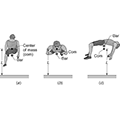
Fig. 1-13a). In a straddle jump, the body is laid out horizontally and can pass over the bar with the bar much closer to the center of mass, and so the bar can be higher (
Fig. 1-13b). In a flop, the curvature of the body around the bar lowers the center of mass to a point below the body, and the athlete can pass over an even higher bar than with a straddle jump (
Fig. 1-13c). The last-moment twist and backward leap in a flop also gives a stronger launch.
| | | |  | FIGURE 1-13 | / Item 1.38 The (a) hurdle, (b) straddle, and (c) flop styles of high jumping.
|
| |
| |
| | | | | | FIGURE 1-13 | / Item 1.38 The (a) hurdle, (b) straddle, and (c) flop styles of high jumping.
|
| |
| |
The approach to the jump is slow compared to, say, a sprint, because the key to winning is a flawless execution, and so timing is essential. At the end of the approach, the athlete plants the launching foot well ahead of the body’s center of mass, and then, as the launching leg flexes, the body is twisted around that foot. This procedure allows some of the kinetic energy of the run to be stored in the flexing leg. As the leg then pushes against the ground, it propels the athlete upward, transferring some of the stored energy, and also additional energy gained from muscular effort, into the flight of the athlete.
Beamon’s long jump was aided only slightly by the wind and the location. Mexico City is at an altitude of 2300 meters, which is considerably higher than the altitudes of many other locations for the Olympics. The high altitude meant that the air density was low, and so the air drag retarding the jump was smaller than if the jump at been at a lower altitude. The high altitude also meant that the gravitational acceleration was smaller, and so the gravitational pull that opposed Beamon’s launch and that eventually pulled him back to the ground was smaller. The acceleration and pull were further reduced because of the effective centrifugal force on Beamon due to Earth’s rotation. That effective force is larger at lower latitudes, because such places travel faster during the rotation.
However, all of these factors played only a small role in the jump. So, why then did Beamon travel so far? The primary reason is that he hit the launch board while running rapidly. Most long jumpers approach more slowly so as to avoid placing their last step just past the board, which would disqualify the jump. They also want to avoid taking off before the board and losing the solid support it gives during the launch while also losing distance in the jump since the jump is measured from the board. Because the board is only 20 centimeters long, the final step must be planned.
Beamon, who was known for disqualified jumps, apparently decided to gamble on his first try and sprinted to the board. His last step barely avoided extending beyond the board. Had he gone beyond the board, he presumably would have made his next two jumps with more concern about the board and less speed.
No one jumped as far as Beamon, including Beamon himself, for the next 23 years. Then, finally, at the 1991 World Track and Field Championship, Mike Powell jumped 8.95 meters—2.0 inches farther than Beamon. He did it in Tokyo and thus without any benefit of higher altitude, and he did it with only a mild wind of 0.3 meter per second at his back. Powell stunningly demonstrated that the effects of altitude and wind are secondary to athletic ability.
To consider the reorientation of a long jumper during flight, suppose that the jump is to the right in your perspective. During the launch from the board, the force on the launching foot from the board produces a clockwise rotation of the body, which tends to bring the trunk of the body forward and the forward leg rearward. This tendency of clockwise rotation is increased as the trailing leg is brought forward to ready for the landing. The reason is that the jumper is then free of the ground, and so the angular momentum of the body must remain constant. So, when the trailing leg is rotated counterclockwise to be forward, the rest of the body tends to rotate clockwise.
To decrease the clockwise rotation, so that the jumper is in the proper orientation for landing, the arms are rapidly swung clockwise about the shoulders. In addition, the legs might continue to move as in running, with a leg outstretched when rotated clockwise to the rear and pulled in when rotated counterclockwise to the front. (None of this motion alters how far the jumper goes; it only alters the orientation of the body.) Novice jumpers often fail to swing the arms sufficiently or, worse, they swing one or both arms in the wrong direction. The trunk and legs are then not in the best orientation, and the jump is short because the heel marks are short or the buttocks erase the heel marks.
The halteres used by jumpers in the ancient Olympiads could increase the length of the jump. An athlete would swing the handheld objects forward and backward in preparation for a jump, then swing them forward during the first part of the jump, and finally swing them backward in preparation for the landing. Properly used, this technique could add 10 or 20 centimeters to the length of the jump for two reasons. (1) As the center of mass of the athlete-halteres system moved through the air, the last backward swing shifted the halteres backward relative to the center of mass and thus shifted the athlete forward relative to the center of mass. (2) During the launch, the forward swing of the halteres increased the downward force on the launch point, thereby giving a greater launch force on the athlete. (In effect, the athlete was using shoulder and arm muscles in addition to the leg muscles during the launch.) A jump could have been increased a bit more if the athlete would have hurled the halteres backwards during the last part of the flight, effectively rocketing the body forward. The center of mass of the athlete-halteres system still lands at the same point, but the athlete is now a bit forward of that point.
|
| Copyright © 2007 John Wiley & Sons, Inc. All rights reserved. |