 | The following is an excerpt from Jearl Walker's THE FLYING CIRCUS OF PHYSICS, 2nd edition. The Flying
Circus is a compendium of interesting real world phenomena that can be explained using basic laws of physics. For more
information about this text, please visit www.wiley.com/college/walker |
| 1.31 | Siege machine |
 |
|
Suppose that you are in a medieval siege of a heavily fortified castle. You don’t want to get too close to the castle because of the archers on the fortress walls. From a distance, how could you attack the walls?
Answer Two main types of siege machines were used to attack fortified walls: the catapult and the trebuchet. The catapult was effectively a bow that fired an arrow or a stone (perhaps 25 kilograms). The machine was much bigger than an archer’s bow, the arrow could have been 2 meters long, and the string was ratcheted back so that far more energy could be stored and then transferred to the arrow during launch. Still, the arrows could do little damage against a stone wall because both the energy and momentum of the arrow were not large.
The trebuchet was far more destructive, and some models could hurl 1300 kilogram stones. They could also hurl dead horses or even bundles of human corpses. The latter was used when an attacking army was ravished by the Black Death and they wished to send the disease into the fortress to infect the defenders. In more humorous situations, modern trebuchets have been used to hurl pianos and even small cars.
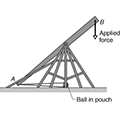
Figure 1-10 gives the essential trebuchet design. A projectile lies in a pouch that is attached to end
A of a long wood beam. A large downward force is suddenly applied to end
B so that the beam is rotated around an axle and the pouch is rapidly brought up and then over the machine. As the pouch and projectile pass over the machine, the pouch’s tie on the beam slips off a hook and then they fly through the air. The energy given to the projectile thus comes from the work done by the force applied at end
B.
| | | |  | FIGURE 1-10 | / Item 1.31 Trebuchet.
|
| |
| |
That force could simply be the coordinated downward pull by several men. However, the trebuchets that could hurl large objects significant distances used a heavy counterweight at B; then the applied force was the gravitational force acting on the counterweight. The counterweight was first gradually lifted by men using a ratchet. Then the counterweight was allowed to fall so that some of the gravitational potential energy stored in it by the men could be transferred to the kinetic energy of the projectile. The kinetic energy and momentum of the projectile were very large and if the projectile was stone, it could knock a hole into a fortress wall. Once trebuchet use became widespread, castle walls were redesigned so that they could better withstand the impacts. For example, some walls were slanted instead of vertical so that the projectile might move somewhat along the wall instead of directly into it.
|
| Copyright © 2007 John Wiley & Sons, Inc. All rights reserved. |