
| For a guided interactive solution, go to Web Example 2-9 at www.wiley.com/college/touger |  |
A pinball machine slopes slightly downward toward the player (Figure 2-19). Dastardly Dude, local pinball champ, gets the feel of the plunger by first shooting the ball gently enough so that it rolls back to the plunger. When he does so, the ball leaves the plunger with an initial velocity of 0.60 m/s. Its velocity 1.0 s later is 0.30 m/s.
|
a. |
Find the ball's acceleration. |
|
|
|
b. |
Find its velocity every half second from t = 0 to t = 4 s. |
|
|
|
c. |
Find its distance from the plunger every half second from t = 0 to t = 4 s. |
|
|
|
d. |
Sketch graphs of x versus t, v versus t, and a versus t for the time period from t = 0 to t = 4 s. |
|
|
Brief Solution
Restating the question. If xo = 0, then in part c we need only find x.
What we know/what we don't.
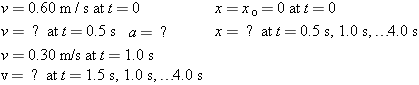 |
Choice of approach. When the acceleration is uniform, we can use the definition of average acceleration to find a. Once a is known, we can use Equation 2-9 to find v at other values of t and Equation 2-11 to find x at each value of t.
Mathematical solution to parts a– c. The definition gives us
 |
Sample calculation. When t = 1.5 s,
 |
 |
Graphing the Results. The resulting graphs are summarized in Figure 2-19 b–d. To obtain the a versus t graph, recall that a is uniform; its value is −0.30 (m/s)/s at every value of t.
|
 Related homework: Problems 2-40 and 2-41. Related homework: Problems 2-40 and 2-41. |