In Concept Simulation 10.3 you can explore the concepts that are important in this problem. A block of mass m =0.750 kg is fastened to an unstrained horizontal spring whose spring constant is k=82.0 N/m. The block is given a displacement of +0.120 m, where the + sign indicates that the displacement is along the +x axis, and then released from rest. (a) What is the force (magnitude and direction) that the spring exerts on the block just before the block is released? (b) Find the angular frequency w of the resulting oscillatory motion. (c) What is the maximum speed of the block? (d) Determine the magnitude of the maximum acceleration of the block.
|
A spiral staircase winds up to the top of a tower in an old castle. To measure the height of the tower, a rope is attached to the top of the tower and hung down the center of the staircase. However, nothing is available with which to measure the length of the rope. Therefore, at the bottom of the rope a small object is attached so as to form a simple pendulum that just clears the floor. The period of the pendulum is measured to be 9.2 s. What is the height of the tower?
| | |
A person bounces up and down on a trampoline, while always staying in contact with it. The motion is simple harmonic motion, and it takes 1.90 s to complete one cycle. The height of each bounce above the equilibrium position is 45.0 cm. Determine (a) the amplitude and (b) the angular frequency of the motion. (c) What is the maximum speed attained by the person?
A person who weighs 670 N steps onto a spring scale in the bathroom, and the spring compresses by 0.79 cm. (a) What is the spring constant? (b) What is the weight of another person who compresses the spring by 0.34 cm?
In Figure 10.9, the radius of the reference circle is 0.500 m. Suppose the frequency of the simple harmonic motion of the shadow is 2.00 Hz. At time t=0.0500 s, calculate (a) the displacement x, (b) the magnitude of the velocity, and (c) the magnitude of the acceleration of the shadow.
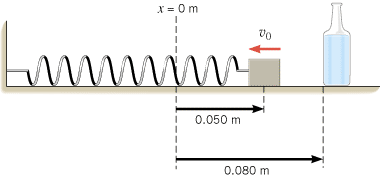
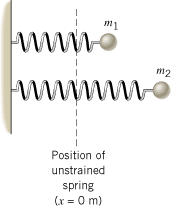
A block rests on a frictionless horizontal surface and is attached to a spring. When set into simple harmonic motion, the block oscillates back and forth with an angular frequency of 7.0 rad/s. The drawing shows the position of the block when the spring is unstrained. This position is labeled “x=0 m.” The drawing also shows a small bottle located 0.080 m to the right of this position. The block is pulled to the right, stretching the spring by 0.050 m, and is then thrown to the left. In order for the block to knock over the bottle, it must be thrown with a speed exceeding v0. Ignoring the width of the block, find v0.
|
Consult Interactive Solution 10.77 to explore a model for solving this problem. A spring is compressed by 0.0620 m and is used to launch an object horizontally with a speed of 1.50 m/s. If the object were attached to the spring, at what angular frequency (in rad/s) would it oscillate?
| | |
A piece of mohair from an Angora goat has a radius of 31×10–6 m. What is the least number of identical pieces of mohair that should be used to suspend a 75-kg person, so the strain DL/L0 experienced by each piece is less than 0.010? Assume that the tension is the same in all the pieces.
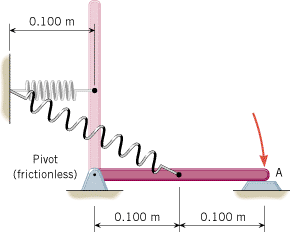
A 0.200-m uniform bar has a mass of 0.750 kg and is released from rest in the vertical position, as the drawing indicates. The spring is initially unstrained and has a spring constant of k= 25.0 N/m. Find the tangential speed with which end A strikes the horizontal surface.
|
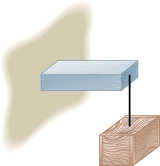
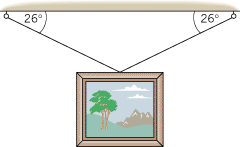
A steel wire is strung between two supports attached to a ceiling. Initially, there is no tension in the wire when it is horizontal. A 96-N picture is then hung from the center of the wire, as the drawing illustrates, so the ends of the wire make angles of 26° with respect to the horizontal. What is the radius of the wire?
| | |
A copper rod (length=2.0 m, radius=3.0×10⁻³ m) hangs down from the ceiling. A 9.0-kg object is attached to the lower end of the rod. The rod acts as a “spring,” and the object oscillates vertically with a small amplitude. Ignoring the rod’s mass, find the frequency f of the simple harmonic motion.
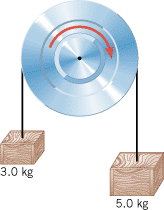
The drawing shows two crates that are connected by a steel wire that passes over a pulley. The unstretched length of the wire is 1.5 m, and its cross-sectional area is 1.3× 10⁻⁵ m2. The pulley is frictionless and massless. When the crates are accelerating, determine the change in length of the wire. Ignore the mass of the wire.
|
| Copyright © 2000-2003 by John Wiley & Sons, Inc. or related companies. All rights reserved. |