|
Concept Simulation 18.2 provides background concerning the electric field lines that are the focus of this problem. Review the important features of electric field lines discussed in Conceptual Example 12. Three point charges (+q, +2q, and –3q) are at the corners of an equilateral triangle. Sketch in six electric field lines between the three charges.
|  | |
|
Two very small spheres are initially neutral and separated by a distance of 0.50 m. Suppose that 3.0×10¹³ electrons are removed from one sphere and placed on the other. (a) What is the magnitude of the electrostatic force that acts on each sphere? (b) Is the force attractive or repulsive? Why?
| | |
|
Conceptual Example 13 deals with the hollow spherical conductor in Figure 18.31. The conductor is initially electrically neutral, and then a charge +q is placed at the center of the hollow space. Suppose the conductor initially has a net charge of +2q instead of being neutral. What is the total charge on the interior and on the exterior surface when the +q charge is placed at the center?
| | |
Four point charges have the same magnitude of 2.4×10⁻¹² C and are fixed to the corners of a square that is 4.0 cm on a side. Three of the charges are positive and one is negative. Determine the magnitude of the net electric field that exists at the center of the square.
|
A charge of +3.0×10⁻⁵ C is located at a place where there is an electric field that points due east and has a magnitude of 15 000 N/C. What are the magnitude and direction of the force acting on the charge?
| | |
A long, thin rod (length=4.0 m) lies along the x axis, with its midpoint at the origin. In a vacuum, a +8.0 mC point charge is fixed to one end of the rod, and a –8.0 mC point charge is fixed to the other end. Everywhere in the x, y plane there is a constant external electric field (magnitude=5.0×10³ N/C) that is perpendicular to the rod. With respect to the z axis, find the magnitude of the net torque applied to the rod.
Two small charged objects are attached to a horizontal spring, one at each end. The magnitudes of the charges are equal, and the spring constant is 220 N/m. The spring is observed to be stretched by 0.020 m relative to its unstrained length of 0.32 m. Determine (a) the possible algebraic signs and (b) the magnitude of the charges.
A small object, which has a charge q=7.5 mC and mass m=9.0×10⁻⁵ kg, is placed in a constant electric field. Starting from rest, the object accelerates to a speed of 2.0×10³ m/s in a time of 0.96 s. Determine the magnitude of the electric field.
|
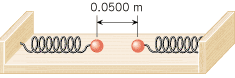
Two spheres are mounted on identical horizontal springs and rest on a frictionless table, as in the drawing. When the spheres are uncharged, the spacing between them is 0.0500 m, and the springs are unstrained. When each sphere has a charge of +1.60 mC, the spacing doubles. Assuming that the spheres have a negligible diameter, determine the spring constant of the springs.
| | |
Two identical small insulating balls are suspended by separate 0.25-m threads that are attached to a common point on the ceiling. Each ball has a mass of 8.0×10⁻⁴ kg. Initially the balls are uncharged and hang straight down. They are then given identical positive charges and, as a result, spread apart with an angle of 36° between the threads. Determine (a) the charge on each ball and (b) the tension in the threads.
|
| Copyright © 2000-2003 by John Wiley & Sons, Inc. or related companies. All rights reserved. |