Focus on Concepts
Note to Instructors: The numbering of the questions shown here reflects the fact that they are only a representative subset of the total number that are available online. However, all of the questions are available for assignment via an online homework management program such as WileyPLUS or WebAssign.

Section 4.2 Newton's First Law of Motion

1.  
An object is moving at a constant velocity. All but one of the following statements could be true. Which one cannot be true?

(a)  

No forces act on the object.

(b)  

A single force acts on the object.

(c)  

Two forces act simultaneously on the object.

(d)  

Three forces act simultaneously on the object.
3.  
A cup of coffee is sitting on a table in a recreational vehicle (RV). The cup slides toward the rear of the RV. According to Newton's first law, which one or more of the following statements could describe the motion of the RV?

A.  
The RV is at rest, and the driver suddenly accelerates.
B.  
The RV is moving forward, and the driver suddenly accelerates.
C.  
The RV is moving backward, and the driver suddenly hits the brakes.


(a)  

A

(b)  

B

(c)  

C

(d)  

A and B

(e)  

A, B, and C

Section 4.4 The Vector Nature of Newton's Second Law of Motion

5.  
Two forces act on a moving object that has a mass of 27 kg. One force has a magnitude of 12 N and points due south, while the other force has a magnitude of 17 N and points due west. What is the acceleration of the object?

(a)  

0.63 m/s2 directed 55° south of west

(b)  

0.44 m/s2 directed 24° south of west

(c)  

0.77 m/s2 directed 35° south of west

(d)  

0.77 m/s2 directed 55° south of west

(e)  

1.1 m/s2 directed 35° south of west

Section 4.5 Newton's Third Law of Motion

7.  
Which one of the following is true, according to Newton's laws of motion? Ignore friction.

(a)  

A sports utility vehicle (SUV) hits a stationary motorcycle. Since it is stationary, the motorcycle sustains a greater force than the SUV does.

(b)  

A semitrailer truck crashes all the way through a wall. Since the wall collapses, the wall sustains a greater force than the truck does.

(c)  

Sam (18 years old) and his sister (9 years old) go ice skating. They push off against each other and fly apart. Sam flies off with the greater acceleration.

(d)  

Two astronauts on a space walk are throwing a ball back and forth between each other. In this game of catch the distance between them remains constant.

(e)  

None of the above is true, according to the third law.
8.  
Two ice skaters, Paul and Tom, are each holding on to opposite ends of the same rope. Each pulls the other toward him. The magnitude of Paul's acceleration is 1.25 times greater than the magnitude of Tom's acceleration. What is the ratio of Paul's mass to Tom's mass?

(a)  

0.67

(b)  

0.80

(c)  

0.25

(d)  

1.25

(e)  

0.50

Section 4.7 The Gravitational Force

9.  
In another solar system a planet has twice the earth's mass and three times the earth's radius. Your weight on this planet is _________ times your earth-weight. Assume that the masses of the earth and of the other planet are uniformly distributed.

(a)  

0.667

(b)  

2.000

(c)  

0.111

(d)  

0.444

(e)  

0.222
11.  
What is the mass on Mercury of an object that weighs 784 N on the earth's surface?

(a)  

80.0 kg

(b)  

48.0 kg

(c)  

118 kg

(d)  

26.0 kg

(e)  

There is not enough information to calculate the mass.

Section 4.8 The Normal Force

12.  
The apparent weight of a passenger in an elevator is greater than his true weight. Which one of the following is true?

(a)  

The elevator is either moving upward with an increasing speed or moving upward with a decreasing speed.

(b)  

The elevator is either moving upward with an increasing speed or moving downward with an increasing speed.

(c)  

The elevator is either moving upward with a decreasing speed or moving downward with a decreasing speed.

(d)  

The elevator is either moving upward with an increasing speed or moving downward with a decreasing speed.

(e)  

The elevator is either moving upward with a decreasing speed or moving downward with an increasing speed.
13.  
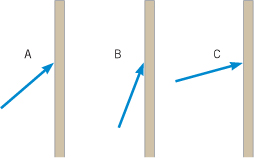
The drawings show three examples of the force with which someone pushes against a vertical wall. In each case the magnitude of the pushing force is the same. Rank the normal forces that the wall applies to the pusher in ascending order (smallest first).

(a)  
C, B, A
(b)  
B, A, C
(c)  
A, C, B
(d)  
B, C, A
(e)  
C, A, B

Section 4.9 Static and Kinetic Frictional Forces

15.  
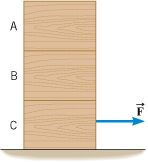
The drawing shows three blocks, each with the same mass, stacked one upon the other. The bottom block rests on a frictionless horizontal surface and is being pulled by a force that is parallel to this surface. The surfaces where the blocks touch each other have identical coefficients of static friction. Which one of the following correctly describes the magnitude of the net force of static friction fs that acts on each block?

(a)  

(b)  

(c)  

(d)  

(e)  

16.  
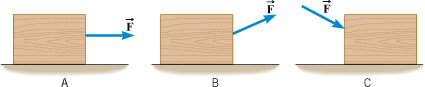
Three identical blocks are being pulled or pushed across a horizontal surface by a force , as shown in the drawings. The force in each case has the same magnitude. Rank the kinetic frictional forces that act on the blocks in ascending order (smallest first).

(a)  
B, C, A
(b)  
C, A, B
(c)  
B, A, C
(d)  
C, B, A
(e)  
A, C, B

Section 4.10 The Tension Force

18.  
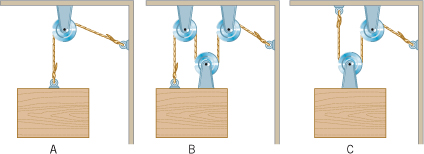
A heavy block is suspended from a ceiling using pulleys in three different ways, as shown in the drawings. Rank the tension in the rope that passes over the pulleys in ascending order (smallest first).

(a)  
B, A, C
(b)  
C, B, A
(c)  
A, B, C
(d)  
C, A, B
(e)  
B, C, A

Question 18

Section 4.11 Equilibrium Applications of Newton's Laws of Motion

20.  
A certain object is in equilibrium. Which one of the following statements is not true?

(a)  

The object must be at rest.

(b)  

The object has a constant velocity.

(c)  

The object has no acceleration.

(d)  

No net force acts on the object.
23.  
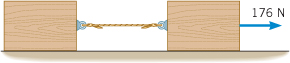
Two identical boxes are being pulled across a horizontal floor at a constant velocity by a horizontal pulling force of 176 N that is applied to one of the boxes, as the drawing shows. There is kinetic friction between each box and the floor. Find the tension in the rope between the boxes.

(a)  

176 N

(b)  

88.0 N

(c)  

132 N

(d)  

44.0 N

(e)  

There is not enough information to calculate the tension.

Section 4.12 Nonequilibrium Applications of Newton's Laws of Motion

25.  
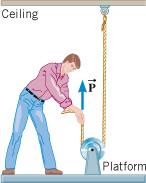
A man is standing on a platform that is connected to a pulley arrangement, as the drawing shows. By pulling upward on the rope with a force the man can raise the platform and himself. The total mass of the man plus the platform is 94.0 kg. What pulling force should the man apply to create an upward acceleration of 1.20 m/s2?


Copyright © 2010 John Wiley & Sons, Inc. All rights reserved.