Problems
Note to Instructors: Most of the homework problems in this chapter are available for assignment via an online homework management program such as WileyPLUS or WebAssign, and those marked with the icon are presented in WileyPLUS using a guided tutorial format that provides enhanced interactivity. See Preface for additional details.

This icon represents a biomedical application.


Section 4.3 Newton's Second Law of Motion

1.  
An airplane has a mass of 3.1 × 10⁴ kg and takes off under the influence of a constant net force of 3.7 × 10⁴ N. What is the net force that acts on the plane's 78-kg pilot?
2.  
Concept Simulation 4.1 reviews the concepts that are important in this problem. The speed of a bobsled is increasing because it has an acceleration of 2.4 m/s2. At a given instant in time, the forces resisting the motion, including kinetic friction and air resistance, total 450 N. The combined mass of the bobsled and its riders is 270 kg. (a) What is the magnitude of the force propelling the bobsled forward? (b) What is the magnitude of the net force that acts on the bobsled?
3.    
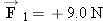
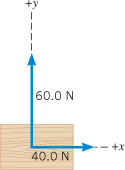
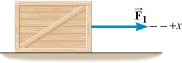
Two horizontal forces, and , are acting on a box, but only is shown in the drawing. can point either to the right or to the left. The box moves only along the x axis. There is no friction between the box and the surface. Suppose that and the mass of the box is 3.0 kg. Find the magnitude and direction of when the acceleration of the box is (a) +5.0 m/s2, (b) -5.0 m/s2, and (c) 0 m/s2.
4.  
In the amusement park ride known as Magic Mountain Superman, powerful magnets accelerate a car and its riders from rest to 45 m/s (about 100 mi/h) in a time of 7.0 s. The combined mass of the car and riders is 5.5 × 10³ kg. Find the average net force exerted on the car and riders by the magnets.
5.  
When a 58-g tennis ball is served, it accelerates from rest to a speed of 45 m/s. The impact with the racket gives the ball a constant acceleration over a distance of 44 cm. What is the magnitude of the net force acting on the ball?
6.  
Review Interactive LearningWare 4.1 in preparation for this problem. During a circus performance, a 72-kg human cannonball is shot out of an 18-m-long cannon. If the human cannonball spends 0.95 s in the cannon, determine the average net force exerted on him in the barrel of the cannon.
7.  
Interactive LearningWare 4.1 reviews the approach taken in problems such as this one. A 1580-kg car is traveling with a speed of 15.0 m/s. What is the magnitude of the horizontal net force that is required to bring the car to a halt in a distance of 50.0 m?
8.    
A person with a black belt in karate has a fist that has a mass of 0.70 kg. Starting from rest, this fist attains a velocity of 8.0 m/s in 0.15 s. What is the magnitude of the average net force applied to the fist to achieve this level of performance?
*9.  
Two forces and are applied to an object whose mass is 8.0 kg. The larger force is . When both forces point due east, the object's acceleration has a magnitude of 0.50 m/s2. However, when points due east and points due west, the acceleration is 0.40 m/s2, due east. Find (a) the magnitude of and (b) the magnitude of .

*10.  
An electron is a subatomic particle (m = 9.11 × 10⁻³¹ kg) that is subject to electric forces. An electron moving in the +x direction accelerates from an initial velocity of +5.40 × 10⁵ m/s to a final velocity of +2.10 × 10⁶ m/s while traveling a distance of 0.038 m. The electron's acceleration is due to two electric forces parallel to the x axis: , and , which points in the -x direction. Find the magnitudes of (a) the net force acting on the electron and (b) the electric force .

Section 4.4 The Vector Nature of Newton's Second Law of Motion, Section 4.5 Newton's Third Law of Motion

11.  
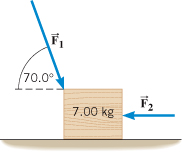
Review Interactive Solution 4.11 before starting this problem. Two forces, and , act on the 7.00-kg block shown in the drawing. The magnitudes of the forces are F1 = 59.0 N and F2 = 33.0 N. What is the horizontal acceleration (magnitude and direction) of the block?
Problem 11
12.  
At an instant when a soccer ball is in contact with the foot of a player kicking it, the horizontal or x component of the ball's acceleration is 810 m/s2 and the vertical or y component of its acceleration is 1100 m/s2. The ball's mass is 0.43 kg. What is the magnitude of the net force acting on the soccer ball at this instant?
13.  
Interactive LearningWare 4.4 provides a review of the concepts that are important in this problem. A rocket of mass 4.50 × 10⁵ kg is in flight. Its thrust is directed at an angle of 55.0° above the horizontal and has a magnitude of 7.50 × 10⁶ N. Find the magnitude and direction of the rocket's acceleration. Give the direction as an angle above the horizontal.
14.  
When a parachute opens, the air exerts a large drag force on it. This upward force is initially greater than the weight of the sky diver and, thus, slows him down. Suppose the weight of the sky diver is 915 N and the drag force has a magnitude of 1027 N. The mass of the sky diver is 93.4 kg. What are the magnitude and direction of his acceleration?
15.  
Airplane flight recorders must be able to survive catastrophic crashes. Therefore, they are typically encased in crash-resistant steel or titanium boxes that are subjected to rigorous testing. One of the tests is an impact shock test, in which the box must survive being thrown at high speeds against a barrier. A 41-kg box is thrown at a speed of 220 m/s and is brought to a halt in a collision that lasts for a time of 6.5 ms. What is the magnitude of the average net force that acts on the box during the collision?
16.    
Two skaters, a man and a woman, are standing on ice. Neglect any friction between the skate blades and the ice. The mass of the man is 82 kg, and the mass of the woman is 48 kg. The woman pushes on the man with a force of 45 N due east. Determine the acceleration (magnitude and direction) of (a) the man and (b) the woman.
*17.  
A duck has a mass of 2.5 kg. As the duck paddles, a force of 0.10 N acts on it in a direction due east. In addition, the current of the water exerts a force of 0.20 N in a direction of 52° south of east. When these forces begin to act, the velocity of the duck is 0.11 m/s in a direction due east. Find the magnitude and direction (relative to due east) of the displacement that the duck undergoes in 3.0 s while the forces are acting.
**18.  
At a time when mining asteroids has become feasible, astronauts have connected a line between their 3500-kg space tug and a 6200-kg asteroid. Using their tug's engine, they pull on the asteroid with a force of 490 N. Initially the tug and the asteroid are at rest, 450 m apart. How much time does it take for the tug and the asteroid to meet?
**19.  
A 325-kg boat is sailing 15.0° north of east at a speed of 2.00 m/s. Thirty seconds later, it is sailing 35.0° north of east at a speed of 4.00 m/s. During this time, three forces act on the boat: a 31.0-N force directed 15.0° north of east (due to an auxiliary engine), a 23.0-N force directed 15.0° south of west (resistance due to the water), and (due to the wind). Find the magnitude and direction of the force . Express the direction as an angle with respect to due east.

Section 4.7 The Gravitational Force

20.    
A 5.0-kg rock and a 3.0 × 10⁻⁴-kg pebble are held near the surface of the earth. (a) Determine the magnitude of the gravitational force exerted on each by the earth. (b) Calculate the magnitude of the acceleration of each object when released.
21.  
In preparation for this problem, review Conceptual Example 7. A space traveler whose mass is 115 kg leaves earth. What are his weight and mass (a) on earth and (b) in interplanetary space where there are no nearby planetary objects?
22.  
A 55-kg bungee jumper has fallen far enough that her bungee cord is beginning to stretch and resist her downward motion. Find the force (magnitude and direction) exerted on her by the bungee cord at an instant when her downward acceleration has a magnitude of 7.6 m/s2. Ignore the effects of air resistance.
23.    
A raindrop has a mass of 5.2 × 10⁻⁷ kg and is falling near the surface of the earth. Calculate the magnitude of the gravitational force exerted (a) on the raindrop by the earth and (b) on the earth by the raindrop.
24.  
A bowling ball (mass = 7.2 kg, radius = 0.11 m) and a billiard ball (mass = 0.38 kg, radius = 0.028 m) may each be treated as uniform spheres. What is the magnitude of the maximum gravitational force that each can exert on the other?
25.  
Saturn has an equatorial radius of 6.00 × 10⁷ m and a mass of 5.67 × 1026 kg. (a) Compute the acceleration of gravity at the equator of Saturn. (b) What is the ratio of a person's weight on Saturn to that on earth?
26.  
Review Conceptual Example 7 in preparation for this problem. In tests on earth a lunar surface exploration vehicle (mass = 5.90 × 10³ kg) achieves a forward acceleration of 0.220 m/s2. To achieve this same acceleration on the moon, the vehicle's engines must produce a drive force of 1.43 × 10³ N. What is the magnitude of the frictional force that acts on the vehicle on the moon?
27.  
Synchronous communications satellites are placed in a circular orbit that is 3.59 × 10⁷ m above the surface of the earth. What is the magnitude of the acceleration due to gravity at this distance?
28.  
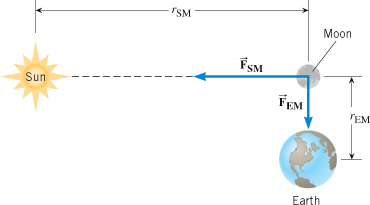
The drawing (not to scale) shows one alignment of the sun, earth, and moon. The gravitational force that the sun exerts on the moon is perpendicular to the force that the earth exerts on the moon. The masses are: mass of sun = 1.99 × 1030 kg, mass of earth = 5.98 × 1024 kg, mass of moon = 7.35 × 10²² kg. The distances shown in the drawing are rSM = 1.50 × 10¹¹ m and rEM = 3.85 × 10⁸ m. Determine the magnitude of the net gravitational force on the moon.
29.  
(a) Calculate the magnitude of the gravitational force exerted on a 425-kg satellite that is a distance of two earth radii from the center of the earth. (b) What is the magnitude of the gravitational force exerted on the earth by the satellite? (c) Determine the magnitude of the satellite's acceleration. (d) What is the magnitude of the earth's acceleration?
30.  
A space traveler weighs 540.0 N on earth. What will the traveler weigh on another planet whose radius is twice that of earth and whose mass is three times that of earth?
31.  
The mass of a robot is 5450 kg. This robot weighs 3620 N more on planet A than it does on planet B. Both planets have the same radius of 1.33 × 10⁷ m. What is the difference MA - MB in the masses of these planets?
*32.  
Three uniform spheres are located at the corners of an equilateral triangle. Each side of the triangle has a length of 1.20 m. Two of the spheres have a mass of 2.80 kg each. The third sphere (mass unknown) is released from rest. Considering only the gravitational forces that the spheres exert on each other, what is the magnitude of the initial acceleration of the third sphere?
*33.  
Several people are riding in a hot-air balloon. The combined mass of the people and balloon is 310 kg. The balloon is motionless in the air, because the downward-acting weight of the people and balloon is balanced by an upward-acting “buoyant” force. If the buoyant force remains constant, how much mass should be dropped overboard so the balloon acquires an upward acceleration of 0.15 m/s2?
*34.  
Jupiter is the largest planet in our solar system, having a mass and radius that are, respectively, 318 and 11.2 times that of earth. Suppose that an object falls from rest near the surface of each planet and that the acceleration due to gravity remains constant during the fall. Each object falls the same distance before striking the ground. Determine the ratio of the time of fall on Jupiter to that on earth.
*35.  
The sun is more massive than the moon, but the sun is farther from the earth. Which one exerts a greater gravitational force on a person standing on the earth? Give your answer by determining the ratio Fsun/Fmoon of the magnitudes of the gravitational forces. Use the data on the inside of the front cover.
*36.  
As a moon follows its orbit around a planet, the maximum gravitational force exerted on the moon by the planet exceeds the minimum gravitational force by 11%. Find the ratio rmax/rmin, where rmax is the moon's maximum distance from the center of the planet and rmin is the minimum distance.
**37.  
Two particles are located on the x axis. Particle 1 has a mass m and is at the origin. Particle 2 has a mass 2m and is at x = +L. A third particle is placed between particles 1 and 2. Where on the x axis should the third particle be located so that the magnitude of the gravitational force on both particle 1 and particle 2 doubles? Express your answer in terms of L.

Section 4.8 The Normal Force, Section 4.9 Static and Kinetic Frictional Forces

38.  
A 35-kg crate rests on a horizontal floor, and a 65-kg person is standing on the crate. Determine the magnitude of the normal force that (a) the floor exerts on the crate and (b) the crate exerts on the person.
39.  
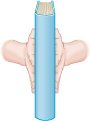
A student presses a book between his hands, as the drawing indicates. The forces that he exerts on the front and back covers of the book are perpendicular to the book and are horizontal. The book weighs 31 N. The coefficient of static friction between his hands and the book is 0.40. To keep the book from falling, what is the magnitude of the minimum pressing force that each hand must exert?
40.  
A 95.0-kg person stands on a scale in an elevator. What is the apparent weight when the elevator is (a) accelerating upward with an acceleration of 1.80 m/s2, (b) moving upward at a constant speed, and (c) accelerating downward with an acceleration of 1.30 m/s2?
41.    
A car is traveling up a hill that is inclined at an angle θ above the horizontal. Determine the ratio of the magnitude of the normal force to the weight of the car when (a) θ = 15° and (b) θ = 35°.
42.  
In a European country a bathroom scale displays its reading in kilograms. When a man stands on this scale, it reads 92.6 kg. When he pulls down on a chin-up bar installed over the scale, the reading decreases to 75.1 kg. What is the magnitude of the force he exerts on the chin-up bar?
43.  
A Mercedes-Benz 300SL (m = 1700 kg) is parked on a road that rises 15° above the horizontal. What are the magnitudes of (a) the normal force and (b) the static frictional force that the ground exerts on the tires?
44.    
Consult Multiple-Concept Example 9 to explore a model for solving this problem. A person pushes on a 57-kg refrigerator with a horizontal force of -267 N; the minus sign indicates that the force points in the -x direction. The coefficient of static friction is 0.65. (a) If the refrigerator does not move, what are the magnitude and direction of the static frictional force that the floor exerts on the refrigerator? (b) What is the magnitude of the largest pushing force that can be applied to the refrigerator before it just begins to move?
45.  
A 20.0-kg sled is being pulled across a horizontal surface at a constant velocity. The pulling force has a magnitude of 80.0 N and is directed at an angle of 30.0° above the horizontal. Determine the coefficient of kinetic friction.
46.  
A 6.00-kg box is sliding across the horizontal floor of an elevator. The coefficient of kinetic friction between the box and the floor is 0.360. Determine the kinetic frictional force that acts on the box when the elevator is (a) stationary, (b) accelerating upward with an acceleration whose magnitude is 1.20 m/s2, and (c) accelerating downward with an acceleration whose magnitude is 1.20 m/s2.
47.  
Review Interactive Solution 4.47 in preparation for this problem. An 81-kg baseball player slides into second base. The coefficient of kinetic friction between the player and the ground is 0.49. (a) What is the magnitude of the frictional force? (b) If the player comes to rest after 1.6 s, what was his initial velocity?
*48.  
Consult Multiple-Concept Example 10 in preparation for this problem. Traveling at a speed of 16.1 m/s, the driver of an automobile suddenly locks the wheels by slamming on the brakes. The coefficient of kinetic friction between the tires and the road is 0.720. What is the speed of the automobile after 1.30 s have elapsed? Ignore the effects of air resistance.
*49.  
Refer to Multiple-Concept Example 10 for help in solving problems like this one. An ice skater is gliding horizontally across the ice with an initial velocity of +6.3 m/s. The coefficient of kinetic friction between the ice and the skate blades is 0.081, and air resistance is negligible. How much time elapses before her velocity is reduced to +2.8 m/s?
*50.  
Multiple-Concept Example 17 reviews the basic concepts involved in this problem. Air rushing over the wings of high-performance race cars generates unwanted horizontal air resistance but also causes a vertical downforce, which helps the cars hug the track more securely. The coefficient of static friction between the track and the tires of a 690-kg race car is 0.87. What is the magnitude of the maximum acceleration at which the car can speed up without its tires slipping when a 4060-N downforce and an 1190-N horizontal-air-resistance force act on it?
**51.  
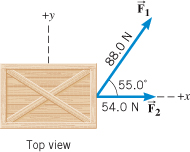
The drawing shows a 25.0-kg crate that is initially at rest. Note that the view is one looking down on the top of the crate. Two forces, and , are applied to the crate, and it begins to move. The coefficient of kinetic friction between the crate and the floor is μk = 0.350. Determine the magnitude and direction (relative to the x axis) of the acceleration of the crate.

Section 4.10 The Tension Force, Section 4.11 Equilibrium Applications of Newton's Laws of Motion

52.  
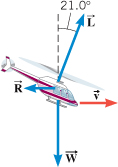
Review Interactive LearningWare 4.3 in preparation for this problem. The helicopter in the drawing is moving horizontally to the right at a constant velocity. The weight of the helicopter is W = 53 800 N. The lift force generated by the rotating blade makes an angle of 21.0° with respect to the vertical. (a) What is the magnitude of the lift force? (b) Determine the magnitude of the air resistance that opposes the motion.
53.  
Three forces act on a moving object. One force has a magnitude of 80.0 N and is directed due north. Another has a magnitude of 60.0 N and is directed due west. What must be the magnitude and direction of the third force, such that the object continues to move with a constant velocity?
54.  
A supertanker (mass = 1.70 × 10⁸ kg) is moving with a constant velocity. Its engines generate a forward thrust of 7.40 × 10⁵ N. Determine (a) the magnitude of the resistive force exerted on the tanker by the water and (b) the magnitude of the upward buoyant force exerted on the tanker by the water.
55.  
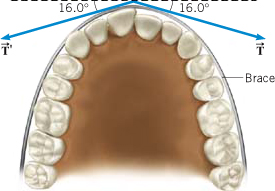
The drawing shows a wire tooth brace used by orthodontists. The topmost tooth is protruding slightly, and the tension in the wire exerts two forces and on this tooth in order to bring it back into alignment. If the forces have the same magnitude of 21.0 N, what is the magnitude of the net force exerted on the tooth by these forces?
56.  
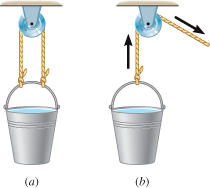
Part a of the drawing shows a bucket of water suspended from the pulley of a well; the tension in the rope is 92.0 N. Part b shows the same bucket of water being pulled up from the well at a constant velocity. What is the tension in the rope in part b?
57.  
As preparation for this problem, review Example 13. Suppose that the pilot in Example 13 suddenly jettisons 2800 N of fuel. If the plane is to continue moving with the same velocity under the influence of the same air resistance , by how much does the pilot have to reduce (a) the thrust and (b) the lift?
58.  
A worker stands still on a roof sloped at an angle of 36° above the horizontal. He is prevented from slipping by a static frictional force of 390 N. Find the mass of the worker.
59.    
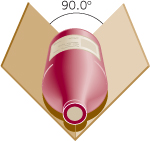
A 1.40-kg bottle of vintage wine is lying horizontally in a rack, as shown in the drawing. The two surfaces on which the bottle rests are 90.0° apart, and the right surface makes an angle of 45.0° with respect to the horizontal. Each surface exerts a force on the bottle that is perpendicular to the surface. Both forces have the same magnitude F. Find the value of F.
60.  
The drawing shows a circus clown who weighs 890 N. The coefficient of static friction between the clown's feet and the ground is 0.53. He pulls vertically downward on a rope that passes around three pulleys and is tied around his feet. What is the minimum pulling force that the clown must exert to yank his feet out from under himself?
*61.  
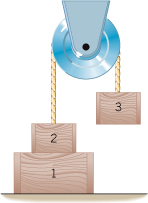
The drawing shows box 1 resting on a table, with box 2 resting on top of box 1. A massless rope passes over a massless, frictionless pulley. One end of the rope is connected to box 2, and the other end is connected to box 3. The weights of the three boxes are W1 = 55 N, W2 = 35 N, and W3 = 28 N. Determine the magnitude of the normal force that the table exerts on box 1.
Problem 61
*62.  
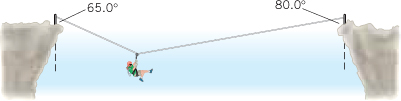
A mountain climber, in the process of crossing between two cliffs by a rope, pauses to rest. She weighs 535 N. As the drawing shows, she is closer to the left cliff than to the right cliff, with the result that the tensions in the left and right sides of the rope are not the same. Find the tensions in the rope to the left and to the right of the mountain climber.
*63.  
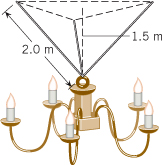
A 44-kg chandelier is suspended 1.5 m below a ceiling by three wires, each of which has the same tension and the same length of 2.0 m (see the drawing). Find the tension in each wire.
*64.  
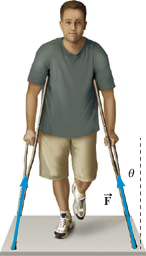
The person in the drawing is standing on crutches. Assume that the force exerted on each crutch by the ground is directed along the crutch, as the force vectors in the drawing indicate. If the coefficient of static friction between a crutch and the ground is 0.90, determine the largest angle θMAX that the crutch can have just before it begins to slip on the floor.
*65.  
Consult Interactive Solution 4.65 before beginning this problem. A toboggan slides down a hill and has a constant velocity. The angle of the hill is 8.00° with respect to the horizontal. What is the coefficient of kinetic friction between the surface of the hill and the toboggan?
*66.    
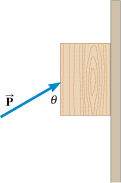
A block is pressed against a vertical wall by a force , as the drawing shows. This force can either push the block upward at a constant velocity or allow it to slide downward at a constant velocity. The magnitude of the force is different in the two cases, while the directional angle θ is the same. Kinetic friction exists between the block and the wall, and the coefficient of kinetic friction is 0.250. The weight of the block is 39.0 N, and the directional angle for the force is θ = 30.0°. Determine the magnitude of when the block slides (a) up the wall and (b) down the wall.
**67.  
A bicyclist is coasting straight down a hill at a constant speed. The combined mass of the rider and bicycle is 80.0 kg, and the hill is inclined at 15.0° with respect to the horizontal. Air resistance opposes the motion of the cyclist. Later, the bicyclist climbs the same hill at the same constant speed. How much force (directed parallel to the hill) must be applied to the bicycle in order for the bicyclist to climb the hill?
**68.  
Review Interactive LearningWare 4.3 in preparation for this problem. A kite is hovering over the ground at the end of a straight 43-m line. The tension in the line has a magnitude of 16 N. Wind blowing on the kite exerts a force of 19 N, directed 56° above the horizontal. Note that the line attached to the kite is not oriented at an angle of 56° above the horizontal. Find the height of the kite, relative to the person holding the line.
**69.  
A damp washcloth is hung over the edge of a table to dry. Thus, part (mass = mon) of the washcloth rests on the table and part (mass = moff) does not. The coefficient of static friction between the table and the washcloth is 0.40. Determine the maximum fraction [moff/(mon + moff)] that can hang over the edge without causing the whole washcloth to slide off the table.

Section 4.12 Nonequilibrium Applications of Newton's Laws of Motion

70.  
A 1450-kg submarine rises straight up toward the surface. Seawater exerts both an upward buoyant force of 16 140 N on the submarine and a downward resistive force of 1030 N. What is the submarine's acceleration?
71.  
Only two forces act on an object (mass = 4.00 kg), as in the drawing. Find the magnitude and direction (relative to the x axis) of the acceleration of the object.
Problem 71
72.  
A fisherman is fishing from a bridge and is using a “45-N test line.” In other words, the line will sustain a maximum force of 45 N without breaking. What is the weight of the heaviest fish that can be pulled up vertically when the line is reeled in (a) at a constant speed and (b) with an acceleration whose magnitude is 2.0 m/s2?
73.  
A 1380-kg car is moving due east with an initial speed of 27.0 m/s. After 8.00 s the car has slowed down to 17.0 m/s. Find the magnitude and direction of the net force that produces the deceleration.
74.  
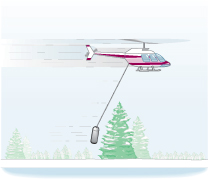
A helicopter flies over the arctic ice pack at a constant altitude, towing an airborne 129-kg laser sensor that measures the thickness of the ice (see the drawing). The helicopter and the sensor both move only in the horizontal direction and have a horizontal acceleration of magnitude 2.84 m/s2. Ignoring air resistance, find the tension in the cable towing the sensor.
75.  
In a supermarket parking lot, an employee is pushing ten empty shopping carts, lined up in a straight line. The acceleration of the carts is 0.050 m/s2. The ground is level, and each cart has a mass of 26 kg. (a) What is the net force acting on any one of the carts? (b) Assuming friction is negligible, what is the force exerted by the fifth cart on the sixth cart?
76.  
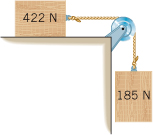
In the drawing, the weight of the block on the table is 422 N and that of the hanging block is 185 N. Ignoring all frictional effects and assuming the pulley to be massless, find (a) the acceleration of the two blocks and (b) the tension in the cord.
77.  
A student is skateboarding down a ramp that is 6.0 m long and inclined at 18° with respect to the horizontal. The initial speed of the skateboarder at the top of the ramp is 2.6 m/s. Neglect friction and find the speed at the bottom of the ramp.
78.  
Review Conceptual Example 16 as background for this problem. The water skier there has a mass of 73 kg. Find the magnitude of the net force acting on the skier when (a) she is accelerated from rest to a speed of 11 m/s in 8.0 s and (b) she lets go of the tow rope and glides to a halt in 21 s.
79.  
A car is towing a boat on a trailer. The driver starts from rest and accelerates to a velocity of +11 m/s in a time of 28 s. The combined mass of the boat and trailer is 410 kg. The frictional force acting on the trailer can be ignored. What is the tension in the hitch that connects the trailer to the car?
80.  
A man seeking to set a world record wants to tow a 109 000-kg airplane along a runway by pulling horizontally on a cable attached to the airplane. The mass of the man is 85 kg, and the coefficient of static friction between his shoes and the runway is 0.77. What is the greatest acceleration the man can give the airplane? Assume that the airplane is on wheels that turn without any frictional resistance.
*81.  
The principles used to solve this problem are similar to those in Multiple-Concept Example 17. A 205-kg log is pulled up a ramp by means of a rope that is parallel to the surface of the ramp. The ramp is inclined at 30.0° with respect to the horizontal. The coefficient of kinetic friction between the log and the ramp is 0.900, and the log has an acceleration of 0.800 m/s2. Find the tension in the rope.
*82.    
To hoist himself into a tree, a 72.0-kg man ties one end of a nylon rope around his waist and throws the other end over a branch of the tree. He then pulls downward on the free end of the rope with a force of 358 N. Neglect any friction between the rope and the branch, and determine the man's upward acceleration.
*83.  
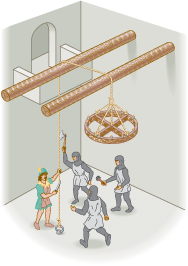
Review Interactive Solution 4.83 before starting this problem. The drawing shows Robin Hood (mass = 77.0 kg) about to escape from a dangerous situation. With one hand, he is gripping the rope that holds up a chandelier (mass = 195 kg). When he cuts the rope where it is tied to the floor, the chandelier will fall, and he will be pulled up toward a balcony above. Ignore the friction between the rope and the beams over which it slides, and find (a) the acceleration with which Robin is pulled upward and (b) the tension in the rope while Robin escapes.
*84.  
A train consists of 50 cars, each of which has a mass of 6.8 × 10³ kg. The train has an acceleration of +8.0 × 10⁻² m/s2. Ignore friction and determine the tension in the coupling (a) between the 30th and 31st cars and (b) between the 49th and 50th cars.
*85.  
Consult Multiple-Concept Example 10 for insight into solving this type of problem. A box is sliding up an incline that makes an angle of 15.0° with respect to the horizontal. The coefficient of kinetic friction between the box and the surface of the incline is 0.180. The initial speed of the box at the bottom of the incline is 1.50 m/s. How far does the box travel along the incline before coming to rest?
*86.  
This problem uses the same concepts as Multiple-Concept Example 17. In Problem 80, an 85-kg man plans to tow a 109 000-kg airplane along a runway by pulling horizontally on a cable attached to it. Suppose that he instead attempts the feat by pulling the cable at an angle of 9.0° above the horizontal. The coefficient of static friction between his shoes and the runway is 0.77. What is the greatest acceleration the man can give the airplane? Assume that the airplane is on wheels that turn without any frictional resistance.
*87.  
The alarm at a fire station rings and an 86-kg fireman, starting from rest, slides down a pole to the floor below (a distance of 4.0 m). Just before landing, his speed is 1.4 m/s. What is the magnitude of the kinetic frictional force exerted on the fireman as he slides down the pole?
*88.    
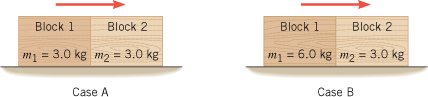
Two blocks are sliding to the right across a horizontal surface, as the drawing shows. In Case A the mass of each block is 3.0 kg. In Case B the mass of block 1 (the block behind) is 6.0 kg, and the mass of block 2 is 3.0 kg. No frictional force acts on block 1 in either Case A or Case B. However, a kinetic frictional force of 5.8 N does act on block 2 in both cases and opposes the motion. For both Case A and Case B determine (a) the magnitude of the forces with which the blocks push against each other and (b) the magnitude of the acceleration of the blocks.
*89.  
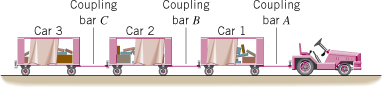
At an airport, luggage is unloaded from a plane into the three cars of a luggage carrier, as the drawing shows. The acceleration of the carrier is 0.12 m/s2, and friction is negligible. The coupling bars have negligible mass. By how much would the tension in each of the coupling bars A, B, and C change if 39 kg of luggage were removed from car 2 and placed in (a) car 1 and (b) car 3? If the tension changes, specify whether it increases or decreases.
*90.  
Consult Interactive LearningWare 4.2 before beginning this problem. A truck is traveling at a speed of 25.0 m/s along a level road. A crate is resting on the bed of the truck, and the coefficient of static friction between the crate and the truck bed is 0.650. Determine the shortest distance in which the truck can come to a halt without causing the crate to slip forward relative to the truck.
**91.  
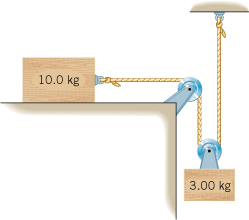
In the drawing, the rope and the pulleys are massless, and there is no friction. Find (a) the tension in the rope and (b) the acceleration of the 10.0-kg block. (Hint: The larger mass moves twice as far as the smaller mass.)
Problem 91
**92.  
A small sphere is hung by a string from the ceiling of a van. When the van is stationary, the sphere hangs vertically. However, when the van accelerates, the sphere swings backward so that the string makes an angle of θ with respect to the vertical. (a) Derive an expression for the magnitude a of the acceleration of the van in terms of the angle θ and the magnitude g of the acceleration due to gravity. (b) Find the acceleration of the van when θ = 10.0°. (c) What is the angle θ when the van moves with a constant velocity?
**93.  
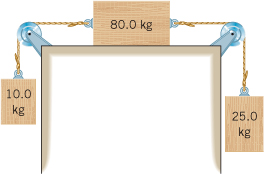
The drawing shows three objects. They are connected by strings that pass over massless and friction-free pulleys. The objects move, and the coefficient of kinetic friction between the middle object and the surface of the table is 0.100. (a) What is the acceleration of the three objects? (b) Find the tension in each of the two strings.
**94.  
A 5.00-kg block is placed on top of a 12.0-kg block that rests on a frictionless table. The coefficient of static friction between the two blocks is 0.600. What is the maximum horizontal force that can be applied before the 5.00-kg block begins to slip relative to the 12.0-kg block, if the force is applied to (a) the more massive block and (b) the less massive block?


Copyright © 2010 John Wiley & Sons, Inc. All rights reserved.