This summary presents an abridged version of the chapter, including the important equations and all available learning aids. For convenient reference, the learning aids (including the text’s examples) are placed next to or immediately after the relevant equation or discussion.
|
Topic
|
Discussion
|
Learning Aids
| |
|
16.1 The Nature of Waves
|
|
Transverse wave
Longitudinal wave
|
A wave is a traveling disturbance and carries energy from place to place. In a transverse wave, the disturbance occurs perpendicular to the direction of travel of the wave. In a longitudinal wave, the disturbance occurs parallel to the line along which the wave travels.
|
|
|
16.2 Periodic Waves
|
|
Cycle
Amplitude
|
A periodic wave consists of cycles or patterns that are produced over and over again by the source of the wave. The amplitude of the wave is the maximum excursion of a particle of the medium from the particle’s undisturbed position.
|
|
Wavelength
Period
Frequency
|
The wavelength l is the distance along the length of the wave between two successive equivalent points, such as two crests or two troughs. The period T is the time required for the wave to travel a distance of one wavelength. The frequency f (in hertz) is the number of wave cycles per second that passes an observer and is the reciprocal of the period (in seconds):
|
|
Relation between frequency and period
|
 | (10.5) |  |
|
|
|
The speed v of a wave is related to its wavelength and frequency according to
|
|
Relation between speed, frequency, and wavelength
|
 | (16.1) | |
|
Example 1
|
|
16.3 The Speed of a Wave on a String
|
|
|
The speed of a wave depends on the properties of the medium in which the wave travels. For a transverse wave on a string that has a tension F and a mass per unit length m/L, the wave speed is
|
|
Speed of a wave on a string
|
 | (16.2) | |
|
Examples 2, 3, 11
Concept Simulation 16.1
|
Linear density
|
The mass per unit length is also called the linear density.
|
Interactive Solution 16.17
|
|
16.4 The Mathematical Description of a Wave
|
|
|
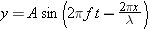
When a wave of amplitude A, frequency f, and wavelength l moves in the +x direction through a medium, the wave causes a displacement y of a particle at position x according to
 | (16.3) | |
For a wave moving in the –x direction, the expression is
 | (16.4) | |
|
Use Self-Assessment Test 16.1 to evaulate your understanding of Sections 16.1, 16.2, 16.3, and 16.4.
|
|
16.5 The Nature of Sound
|
|
Condensation
Rarefaction
|
Sound is a longitudinal wave that can be created only in a medium; it cannot exist in a vacuum. Each cycle of a sound wave includes one condensation (a region of greater than normal pressure) and one rarefaction (a region of less than normal pressure).
|
|
Infrasonic frequency
Ultrasonic frequency
Pitch
|
A sound wave with a single frequency is called a pure tone. Frequencies less than 20 Hz are called infrasonic. Frequencies greater than 20 kHz are called ultrasonic. The brain interprets the frequency detected by the ear primarily in terms of the subjective quality known as pitch. A high-pitched sound is one with a large frequency (e.g., piccolo). A low-pitched sound is one with a small frequency (e.g., tuba).
|
|
Pressure amplitude
Loudness
|
The pressure amplitude of a sound wave is the magnitude of the maximum change in pressure, measured relative to the undisturbed pressure. The pressure amplitude is associated with the subjective quality of loudness. The larger the pressure amplitude, the louder the sound.
|
|
|
16.6 The Speed of Sound
|
|
|
The speed of sound v depends on the properties of the medium. In an ideal gas, the speed of sound is
|
Speed of sound in an ideal gas
|
 | (16.5) | |
|
Examples 4, 5
Interactive LearningWare 16.1
|
|
where g=CP/CV is the ratio of the specific heat capacities at constant pressure and constant volume, k is Boltzmann’s constant, T is the Kelvin temperature, and m is the mass of a molecule of the gas. In a liquid, the speed of sound is
|
|
Speed of sound in a liquid
|
 | (16.6) | |
|
|
|
where Bad is the adiabatic bulk modulus and r is the mass density. In a solid that has a Young’s modulus of Y and the shape of a long slender bar, the speed of sound is
|
|
Speed of sound in solid bar
|
 | (16.7) | |
|
|
|
16.7 Sound Intensity
|
|
Intensity
|
The intensity I of a sound wave is the power P that passes perpendicularly through a surface divided by the area A of the surface
 | (16.8) | |
|
Example 6
Interactive Solution 16.55
|
Threshold of hearing
|
The SI unit for intensity is watts per square meter (W/m2). The smallest sound intensity that the human ear can detect is known as the threshold of hearing and is about 1×10–12 W/m2 for a 1-kHz sound. When a source radiates sound uniformly in all directions and no reflections are present, the intensity of the sound is inversely proportional to the square of the distance from the source, according to
|
|
Spherically uniform radiation
|
 | (16.9) | |
|
Examples 7, 8
|
|
16.8 Decibels
|
|
|
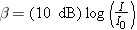
The intensity level b (in decibels) is used to compare a sound intensity I to the sound intensity I0 of a reference level:
|
|
Intensity level in decibels
|
 | (16.10) | |
|
Example 9
|
|
The decibel, like the radian, is dimensionless. An intensity level of zero decibels means that I=I0. One decibel is approximately the smallest change in loudness that an average listener with healthy hearing can detect. An increase of ten decibels in the intensity level corresponds approximately to a doubling of the loudness of the sound.
|
|
|
16.9 The Doppler Effect
|
|
|
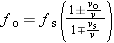
The Doppler effect is the change in frequency detected by an observer because the sound source and the observer have different velocities with respect to the medium of sound propagation. If the observer and source move with speeds vo and vs, respectively, and if the medium is stationary, the frequency fo detected by the observer is
|
|
The Doppler effect
|
 | (16.15) | |
|
Examples 10, 12
Interactive LearningWare 16.2
Interactive Solutions 16.77
|
|
where fs is the frequency of the sound emitted by the source and v is the speed of sound. In the numerator, the plus sign applies when the observer moves toward the source, and the minus sign applies when the observer moves away from the source. In the denominator, the minus sign is used when the source moves toward the observer, and the plus sign is used when the source moves away from the observer.
|
|
Use Self-Assessment Test 16.2 to evaulate your understanding of Sections 16.5, 16.6, 16.7, 16.8, and 16.9.
|
|